1368: William Warded – Excessive Regulations in Drug Development

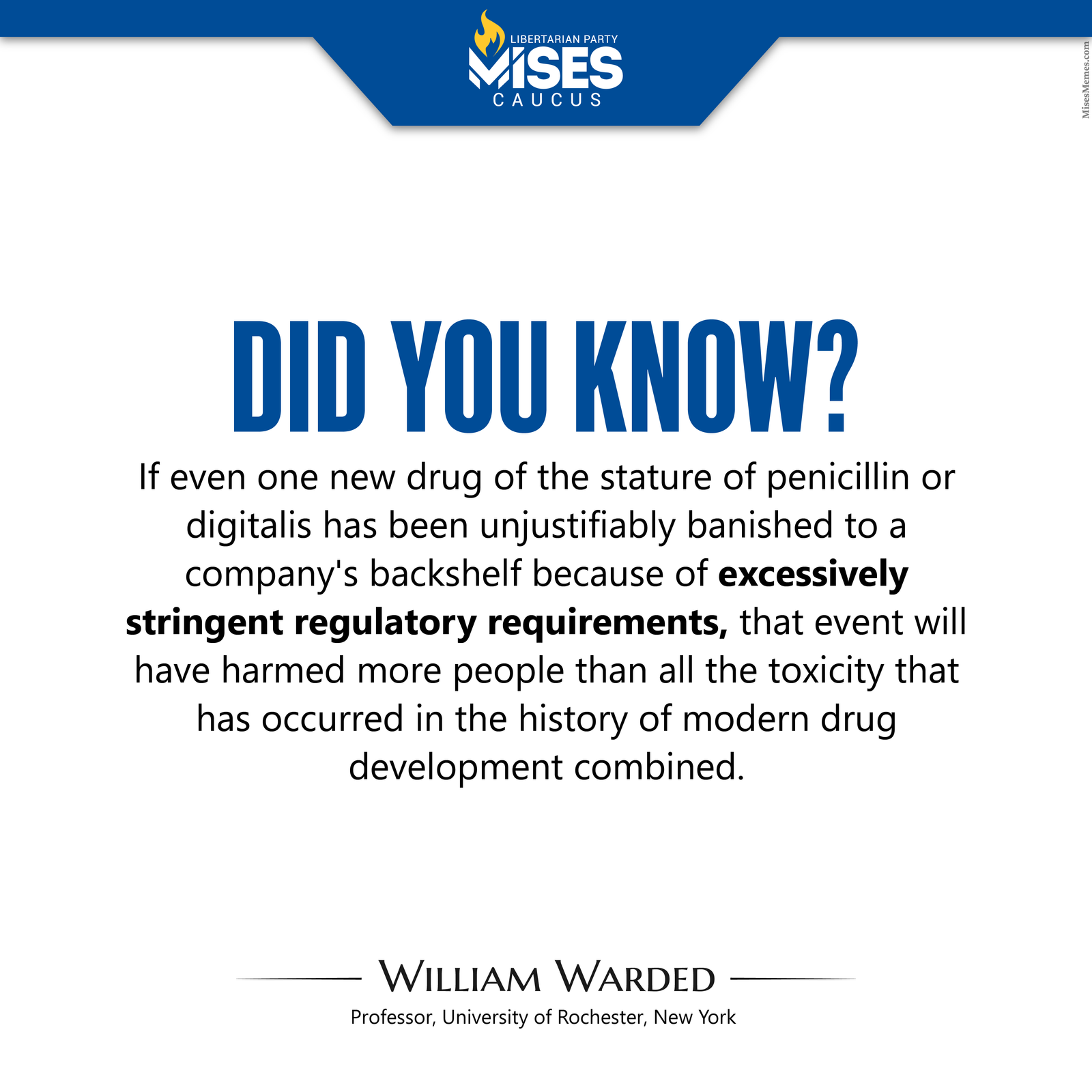
If even one new drug of the stature of penicillin or digitalis has been unjustifiably banished to a company's backshelf because of excessively stringent regulatory requirements, that event will have harmed more people than all the toxicity that has occurred in the history of modern drug development combined. —William Warded
Normal Quality (3840×2010 100 KB)
If even one new drug of the stature of penicillin or digitalis has been unjustifiably banished to a company's backshelf because of excessively stringent regulatory requirements, that event will have harmed more people than all the toxicity that has occurred in the history of modern drug development combined. —William Warded
Normal Quality (3840×3840 244 KB)
Drug development, Drugs, FDA, Government, Health, History, Innovation, Law, Regulations
If even one new drug of the stature of penicillin or digitalis has been unjustifiably banished to a company's backshelf because of excessively stringent regulatory requirements, that event will have harmed more people than all the toxicity that has occurred in the history of modern drug development combined. —William Warded

If even one new drug of the stature of penicillin or digitalis has been unjustifiably banished to a company’s backshelf because of excessively stringent regulatory requirements, that event will have harmed more people than all the toxicity that has occurred in the history of modern drug development combined. —William Warded

1367: Antony Davies – Laws That Harm the Disabled

In 1990, the U.S. government enacted the Americans with Disabilities Act. This law attempted to protect the disabled in the labor market by prohibiting discriminatory behavior on the basis of disability. A law specifically designed to ensure that the disabled got a fair shake in the labor market instead resulted in decreased employment rates for the disabled.
Normal Quality (3072×3840 255 KB)

In 1990, the U.S. government enacted the Americans with Disabilities Act. This law attempted to protect the disabled in the labor market by prohibiting discriminatory behavior on the basis of disability. A law specifically designed to ensure that the disabled got a fair shake in the labor market instead resulted in decreased employment rates for the disabled.

Why? There are a couple of reasons. First, the law made it expensive for businesses to hire the disabled. Regulators have deemed, among other things, that employers will need to modify an employee’s physical environment, offer the employee additional training, give him extra time to complete tasks, and even hire interpreters. All these things increase the cost of doing business.

Second, the law made it difficult to terminate disabled workers, even when warranted. But how is a business to prove that it terminated a disabled worker because of something other than the worker’s disability? The answer that many businesses seem to have arrived at, although few will admit it, is not to hire the disabled in the first place.

It turns out to be easier for an employer to prove that it did not hire a disabled worker for a reason unrelated to the worker’s disability than to prove that it fired the worker for such a reason. Consequently, the Americans with Disabilities Act actually led to a decrease in employment rates for the disabled.

—Antony Davies, James R. Harrigan
1366: Antony Davies – Seat Belt Laws

Forty-nine states now mandate seat belt use and motor vehicle fatalities have decreased. But there is more to the story. As more drivers used seat belts, fatalities for pedestrians and cyclists increased. Why? As seat belt use rose, driving became safer. As driving became safer, the cost to drivers of being inattentive fell. And as the cost of being inattentive fell, drivers could afford to exercise less care. So as safety regulations make drivers safer, pedestrians and cyclists face greater risk. —Antony Davies, James R. Harrigan
Normal Quality (3840×2010 121 KB)
Forty-nine states now mandate seat belt use and motor vehicle fatalities have decreased. But there is more to the story. As more drivers used seat belts, fatalities for pedestrians and cyclists increased. Why? As seat belt use rose, driving became safer. As driving became safer, the cost to drivers of being inattentive fell. And as the cost of being inattentive fell, drivers could afford to exercise less care. So as safety regulations make drivers safer, pedestrians and cyclists face greater risk. —Antony Davies, James R. Harrigan
Normal Quality (3840×3840 310 KB)
Forty-nine states now mandate seat belt use and motor vehicle fatalities have decreased. But there is more to the story. As more drivers used seat belts, fatalities for pedestrians and cyclists increased. Why? As seat belt use rose, driving became safer. As driving became safer, the cost to drivers of being inattentive fell. And as the cost of being inattentive fell, drivers could afford to exercise less care. So as safety regulations make drivers safer, pedestrians and cyclists face greater risk. —Antony Davies, James R. Harrigan

Forty-nine states now mandate seat belt use and motor vehicle fatalities have decreased. But there is more to the story. As more drivers used seat belts, fatalities for pedestrians and cyclists increased. Why? As seat belt use rose, driving became safer. As driving became safer, the cost to drivers of being inattentive fell. And as the cost of being inattentive fell, drivers could afford to exercise less care. So as safety regulations make drivers safer, pedestrians and cyclists face greater risk. —Antony Davies, James R. Harrigan

1365: Antony Davies – Unintended Consequences

In Hanoi during the French colonial period there was a problem with too many rats. The French authorities offered a bounty for every rat killed but required only that people bring the rats’ tails as evidence. Hanoi was soon overrun by tailless rats. The people were simply catching the rats, cutting off their tails, and releasing them. Why? So those rats could procreate, creating more rats and more bounties. In the end, Hanoi had more rats after the bounty than before. Sometimes there are perverse outcomes and unintended consequences of a government policy. —Antony Davies, James R. Harrigan

Normal Quality (3840×2010 124 KB)
In Hanoi during the French colonial period there was a problem with too many rats. The French authorities offered a bounty for every rat killed but required only that people bring the rats’ tails as evidence. Hanoi was soon overrun by tailless rats. The people were simply catching the rats, cutting off their tails, and releasing them. Why? So those rats could procreate, creating more rats and more bounties. In the end, Hanoi had more rats after the bounty than before. Sometimes there are perverse outcomes and unintended consequences of a government policy. —Antony Davies, James R. Harrigan

Normal Quality (3840×3840 308 KB)
In Hanoi during the French colonial period there was a problem with too many rats. The French authorities offered a bounty for every rat killed but required only that people bring the rats’ tails as evidence. Hanoi was soon overrun by tailless rats. The people were simply catching the rats, cutting off their tails, and releasing them. Why? So those rats could procreate, creating more rats and more bounties. In the end, Hanoi had more rats after the bounty than before. Sometimes there are perverse outcomes and unintended consequences of a government policy. —Antony Davies, James R. Harrigan
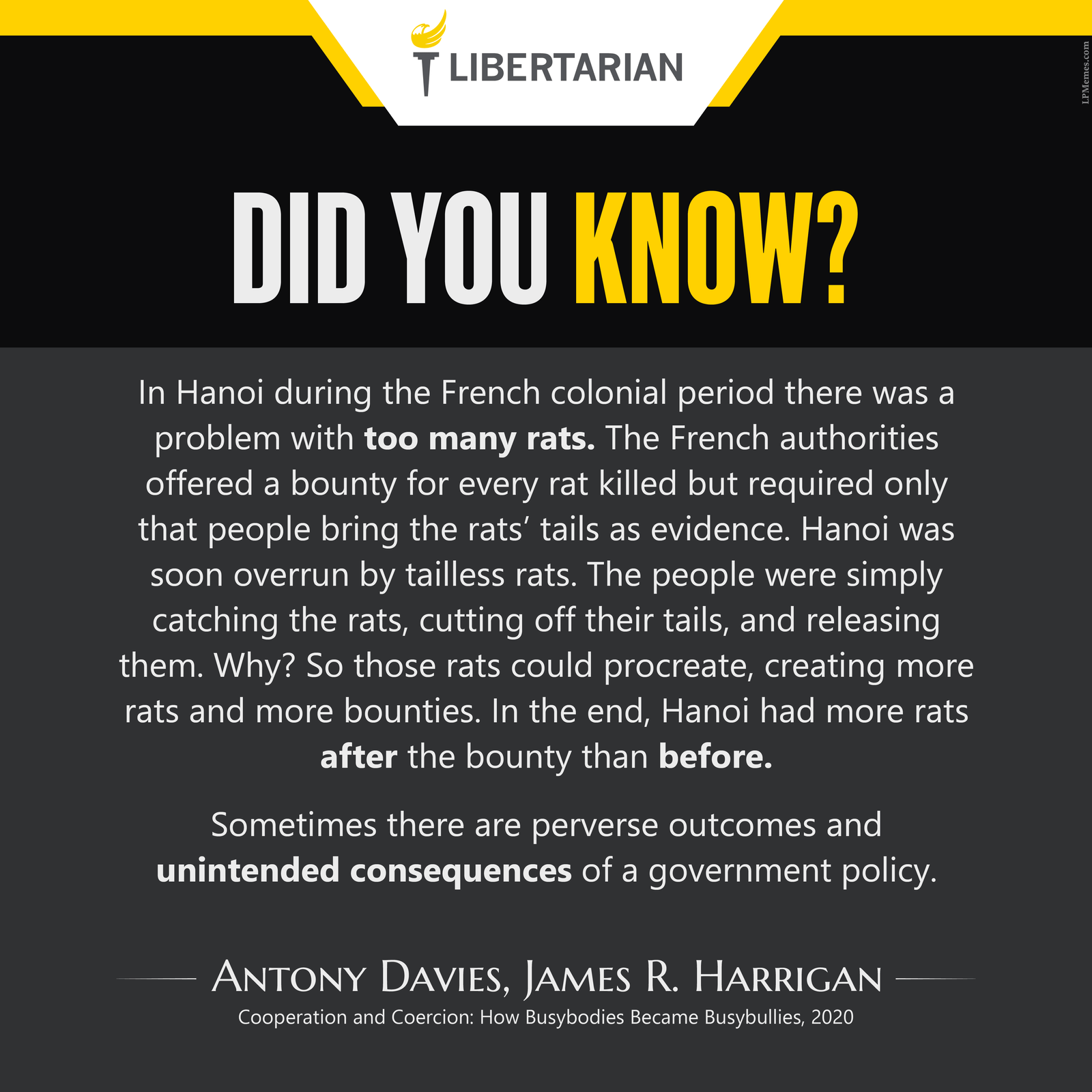
In Hanoi during the French colonial period there was a problem with too many rats. The French authorities offered a bounty for every rat killed but required only that people bring the rats’ tails as evidence. Hanoi was soon overrun by tailless rats. The people were simply catching the rats, cutting off their tails, and releasing them. Why? So those rats could procreate, creating more rats and more bounties. In the end, Hanoi had more rats after the bounty than before. Sometimes there are perverse outcomes and unintended consequences of a government policy. —Antony Davies, James R. Harrigan

1364: Antony Davies – Venezuelan Inflation

To address its cash crunch, the Venezuelan government printed money, which gave birth to rampant inflation. Depending on whom you ask, Venezuela’s annual inflation rate exceeded something between 60,000 percent and 200,000 percent in 2019. To put that in perspective, a product that cost one dollar in January 2019 would cost between $600 and $2,000 by the end of 2019. —Antony Davies, James R. Harrigan

Normal Quality (3840×2010 122 KB)
To address its cash crunch, the Venezuelan government printed money, which gave birth to rampant inflation. Depending on whom you ask, Venezuela’s annual inflation rate exceeded something between 60,000 percent and 200,000 percent in 2019. To put that in perspective, a product that cost one dollar in January 2019 would cost between $600 and $2,000 by the end of 2019. —Antony Davies, James R. Harrigan
Normal Quality (3840×3840 303 KB)
To address its cash crunch, the Venezuelan government printed money, which gave birth to rampant inflation. Depending on whom you ask, Venezuela’s annual inflation rate exceeded something between 60,000 percent and 200,000 percent in 2019. To put that in perspective, a product that cost one dollar in January 2019 would cost between $600 and $2,000 by the end of 2019. —Antony Davies, James R. Harrigan

To address its cash crunch, the Venezuelan government printed money, which gave birth to rampant inflation. Depending on whom you ask, Venezuela’s annual inflation rate exceeded something between 60,000 percent and 200,000 percent in 2019. To put that in perspective, a product that cost one dollar in January 2019 would cost between $600 and $2,000 by the end of 2019. —Antony Davies, James R. Harrigan

1363: Antony Davies – Spontaneous Order

In Nicaragua where sign language didn’t exist, in 1981, a new school for the deaf opened. Fifty deaf students enrolled during the school’s first year, and a curious thing happened: they developed their own version of sign language. No one taught them this; they simply began assigning signs and gestures to the things in their environment, and slowly a language emerged, complete with verb tenses and the like, to rival any other language. Spontaneous orders are systems that develop organically. They aren’t designed by a coercive authority. They emerge through countless human interactions undertaken over time. —Antony Davies, James R. Harrigan

Normal Quality (3840×2010 123 KB)
In Nicaragua where sign language didn’t exist, in 1981, a new school for the deaf opened. Fifty deaf students enrolled during the school’s first year, and a curious thing happened: they developed their own version of sign language. No one taught them this; they simply began assigning signs and gestures to the things in their environment, and slowly a language emerged, complete with verb tenses and the like, to rival any other language. Spontaneous orders are systems that develop organically. They aren’t designed by a coercive authority. They emerge through countless human interactions undertaken over time. —Antony Davies, James R. Harrigan
Normal Quality (3840×3840 335 KB)
In Nicaragua where sign language didn’t exist, in 1981, a new school for the deaf opened. Fifty deaf students enrolled during the school’s first year, and a curious thing happened: they developed their own version of sign language. No one taught them this; they simply began assigning signs and gestures to the things in their environment, and slowly a language emerged, complete with verb tenses and the like, to rival any other language. Spontaneous orders are systems that develop organically. They aren’t designed by a coercive authority. They emerge through countless human interactions undertaken over time. —Antony Davies, James R. Harrigan
In Nicaragua where sign language didn’t exist, in 1981, a new school for the deaf opened. Fifty deaf students enrolled during the school’s first year, and a curious thing happened: they developed their own version of sign language. No one taught them this; they simply began assigning signs and gestures to the things in their environment, and slowly a language emerged, complete with verb tenses and the like, to rival any other language. Spontaneous orders are systems that develop organically. They aren’t designed by a coercive authority. They emerge through countless human interactions undertaken over time. —Antony Davies, James R. Harrigan
1362: Mary Ruwart – Patients Die Waiting for New Drugs

Cancer patients often die waiting for new drugs to be approved by the FDA? Abigail Burroughs had squamous cell carcinoma, diagnosed when she was only 19 years old. She tried unsuccessfully to get FDA permission to try a new drug (Erbitux) that had shown success against her type of cancer. The FDA refused, and Abigail died at age 21. Abigail’s father formed the Abigail Alliance and sued the FDA. However, the courts ruled that Americans do not have the constitutional right to save their lives with drugs not approved by the FDA. —Mary Ruwart
Normal Quality (3840×2010 128 KB)
Cancer patients often die waiting for new drugs to be approved by the FDA? Abigail Burroughs had squamous cell carcinoma, diagnosed when she was only 19 years old. She tried unsuccessfully to get FDA permission to try a new drug (Erbitux) that had shown success against her type of cancer. The FDA refused, and Abigail died at age 21. Abigail’s father formed the Abigail Alliance and sued the FDA. However, the courts ruled that Americans do not have the constitutional right to save their lives with drugs not approved by the FDA. —Mary Ruwart
Normal Quality (3840×3840 325 KB)
Cancer patients often die waiting for new drugs to be approved by the FDA? Abigail Burroughs had squamous cell carcinoma, diagnosed when she was only 19 years old. She tried unsuccessfully to get FDA permission to try a new drug (Erbitux) that had shown success against her type of cancer. The FDA refused, and Abigail died at age 21. Abigail’s father formed the Abigail Alliance and sued the FDA. However, the courts ruled that Americans do not have the constitutional right to save their lives with drugs not approved by the FDA. —Mary Ruwart

Cancer patients often die waiting for new drugs to be approved by the FDA? Abigail Burroughs had squamous cell carcinoma, diagnosed when she was only 19 years old. She tried unsuccessfully to get FDA permission to try a new drug (Erbitux) that had shown success against her type of cancer. The FDA refused, and Abigail died at age 21. Abigail’s father formed the Abigail Alliance and sued the FDA. However, the courts ruled that Americans do not have the constitutional right to save their lives with drugs not approved by the FDA. —Mary Ruwart

1361: Mary Ruwart – Public Schools are Wasteful

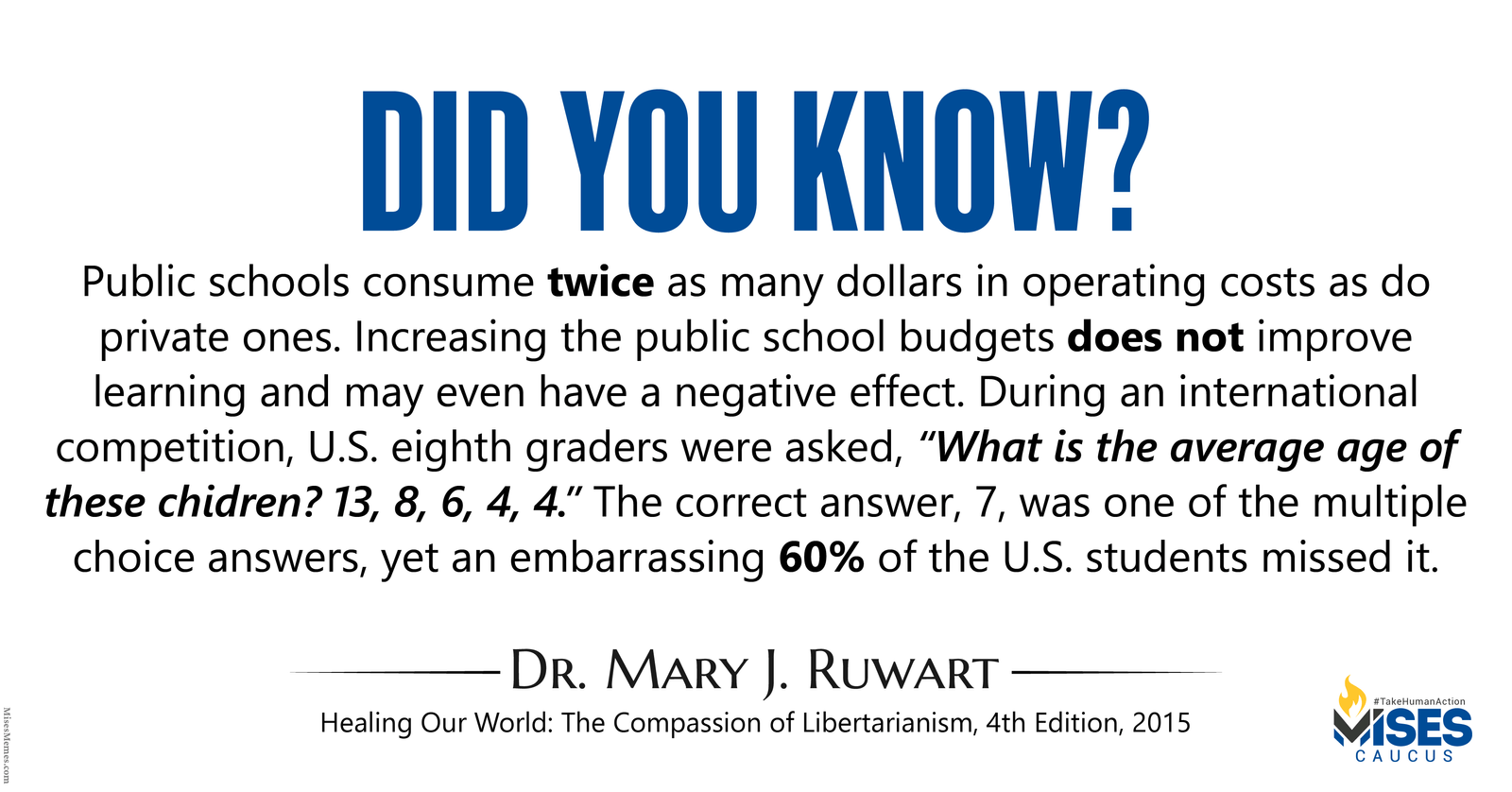
Public schools consume twice as many dollars in operating costs as do private ones. Increasing the public school budgets does not improve learning and may even have a negative effect. During an international competition, U.S. eighth graders were asked, “What is the average age of these chidren? 13, 8, 6, 4, 4.” The correct answer, 7, was one of the multiple choice answers, yet an embarrassing 60% of the U.S. students missed it. —Mary Ruwart
Normal Quality (3840×2010 123 KB)
Public schools consume twice as many dollars in operating costs as do private ones. Increasing the public school budgets does not improve learning and may even have a negative effect. During an international competition, U.S. eighth graders were asked, “What is the average age of these chidren? 13, 8, 6, 4, 4.” The correct answer, 7, was one of the multiple choice answers, yet an embarrassing 60% of the U.S. students missed it. —Mary Ruwart
Normal Quality (3840×3840 303 KB)
Public schools consume twice as many dollars in operating costs as do private ones. Increasing the public school budgets does not improve learning and may even have a negative effect. During an international competition, U.S. eighth graders were asked, “What is the average age of these chidren? 13, 8, 6, 4, 4.” The correct answer, 7, was one of the multiple choice answers, yet an embarrassing 60% of the U.S. students missed it. —Mary Ruwart

Public schools consume twice as many dollars in operating costs as do private ones. Increasing the public school budgets does not improve learning and may even have a negative effect. During an international competition, U.S. eighth graders were asked, “What is the average age of these chidren? 13, 8, 6, 4, 4.” The correct answer, 7, was one of the multiple choice answers, yet an embarrassing 60% of the U.S. students missed it. —Mary Ruwart

1360: Thomas Sowell – Centralized Censorship

The intelligencia in the media can decide what to emphasize, what to downplay and what to ignore entirely when it comes to race. These may be individual choices, rather than a conspiracy, but individual choices growing out of a common vision of the world can produce results all too similar to what is produced by centralized censorship or propaganda. —Thomas Sowell
Normal Quality (1920×1005 254 KB)
The intelligencia in the media can decide what to emphasize, what to downplay and what to ignore entirely when it comes to race. These may be individual choices, rather than a conspiracy, but individual choices growing out of a common vision of the world can produce results all too similar to what is produced by centralized censorship or propaganda. —Thomas Sowell
Normal Quality (1920×1372 376 KB)
The intelligencia in the media can decide what to emphasize, what to downplay and what to ignore entirely when it comes to race. These may be individual choices, rather than a conspiracy, but individual choices growing out of a common vision of the world can produce results all too similar to what is produced by centralized censorship or propaganda. —Thomas Sowell

The intelligencia in the media can decide what to emphasize, what to downplay and what to ignore entirely when it comes to race. These may be individual choices, rather than a conspiracy, but individual choices growing out of a common vision of the world can produce results all too similar to what is produced by centralized censorship or propaganda. —Thomas Sowell

1359: Antony Davies – 22 Trillion on Poverty

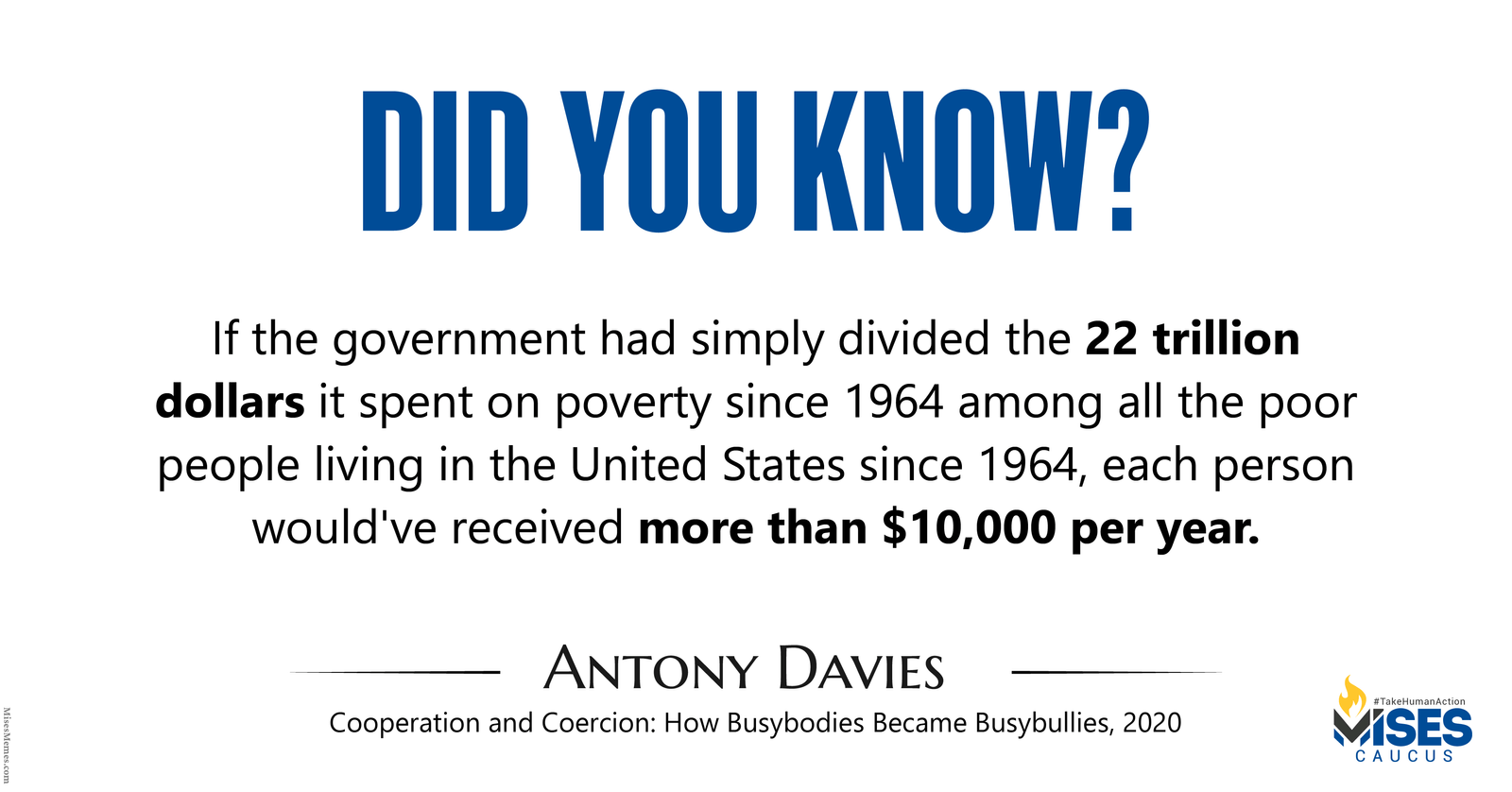
If the government had simply divided the 22 trillion dollars it spent on poverty since 1964 among all the poor people living in the United States since 1964, each person would've received more than $10,000 per year. —Antony Davies
Normal Quality (3840×2010 89 KB)
If the government had simply divided the 22 trillion dollars it spent on poverty since 1964 among all the poor people living in the United States since 1964, each person would've received more than $10,000 per year. —Antony Davies
Normal Quality (3840×3840 238 KB)
If the government had simply divided the 22 trillion dollars it spent on poverty since 1964 among all the poor people living in the United States since 1964, each person would've received more than $10,000 per year. —Antony Davies

If the government had simply divided the 22 trillion dollars it spent on poverty since 1964 among all the poor people living in the United States since 1964, each person would’ve received more than $10,000 per year. —Antony Davies