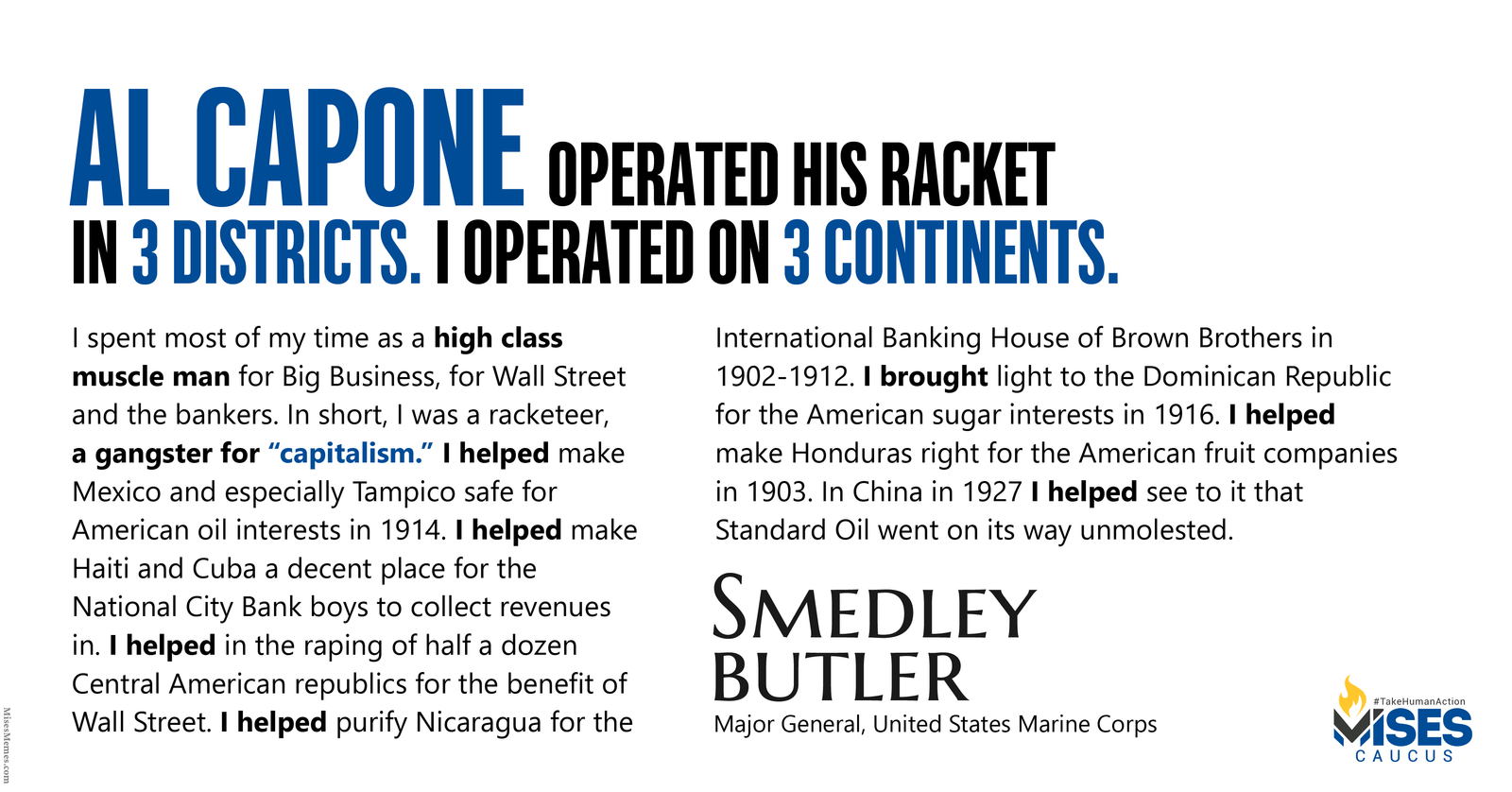
1426 – Smedley Butler – I Operated on 3 Continents

I spent 33 years and four months in active military service and during that period I spent most of my time as a high class muscle man for Big Business, for Wall Street and the bankers. In short, I was a racketeer, a gangster for capitalism. —Smedley Butler, Major General, United States Marine Corps
Download Print Quality (3840×2010 248 KB)  |  Normal Quality (3840×2010 141 KB)
I spent 33 years and four months in active military service and during that period I spent most of my time as a high class muscle man for Big Business, for Wall Street and the bankers. In short, I was a racketeer, a gangster for capitalism. —Smedley Butler, Major General, United States Marine Corps
Download Print Quality (3073×3840 317 KB)  |  Normal Quality (3073×3840 176 KB)
I spent 33 years and four months in active military service and during that period I spent most of my time as a high class muscle man for Big Business, for Wall Street and the bankers. In short, I was a racketeer, a gangster for capitalism. —Smedley Butler, Major General, United States Marine Corps

I spent 33 years and four months in active military service and during that period I spent most of my time as a high class muscle man for Big Business, for Wall Street and the bankers. In short, I was a racketeer, a gangster for capitalism. I helped make Mexico and especially Tampico safe for American oil interests in 1914. I helped make Haiti and Cuba a decent place for the National City Bank boys to collect revenues in. I helped in the raping of half a dozen Central American republics for the benefit of Wall Street. I helped purify Nicaragua for the International Banking House of Brown Brothers in 1902-1912. I brought light to the Dominican Republic for the American sugar interests in 1916. I helped make Honduras right for the American fruit companies in 1903. In China in 1927 I helped see to it that Standard Oil went on its way unmolested. Looking back on it, I might have given Al Capone a few hints. The best he could do was to operate his racket in three districts. I operated on three continents. —Smedley Butler, Major General, United States Marine Corps

1418: Edith Hamilton – Freedom from Responsibility

In the end, more than freedom, they wanted security. They wanted a comfortable life, and they lost it all — security, comfort, and freedom. When the freedom they wished for most was freedom from responsibility, then Athens ceased to be free and was never free again. —Edith Hamilton
Download Print Quality (3840×2010 4 MB)  |  Normal Quality (1920×1005 264 KB)
In the end, more than freedom, they wanted security. They wanted a comfortable life, and they lost it all — security, comfort, and freedom. When the freedom they wished for most was freedom from responsibility, then Athens ceased to be free and was never free again. —Edith Hamilton
Download Print Quality (3840×2743 5 MB)  |  Normal Quality (1920×1372 323 KB)
In the end, more than freedom, they wanted security. They wanted a comfortable life, and they lost it all — security, comfort, and freedom. When the freedom they wished for most was freedom from responsibility, then Athens ceased to be free and was never free again. —Edith Hamilton

In the end, more than freedom, they wanted security. They wanted a comfortable life, and they lost it all — security, comfort, and freedom. When the freedom they wished for most was freedom from responsibility, then Athens ceased to be free and was never free again. —Edith Hamilton

1391: Antony Davies – Not the Poor who Benefit

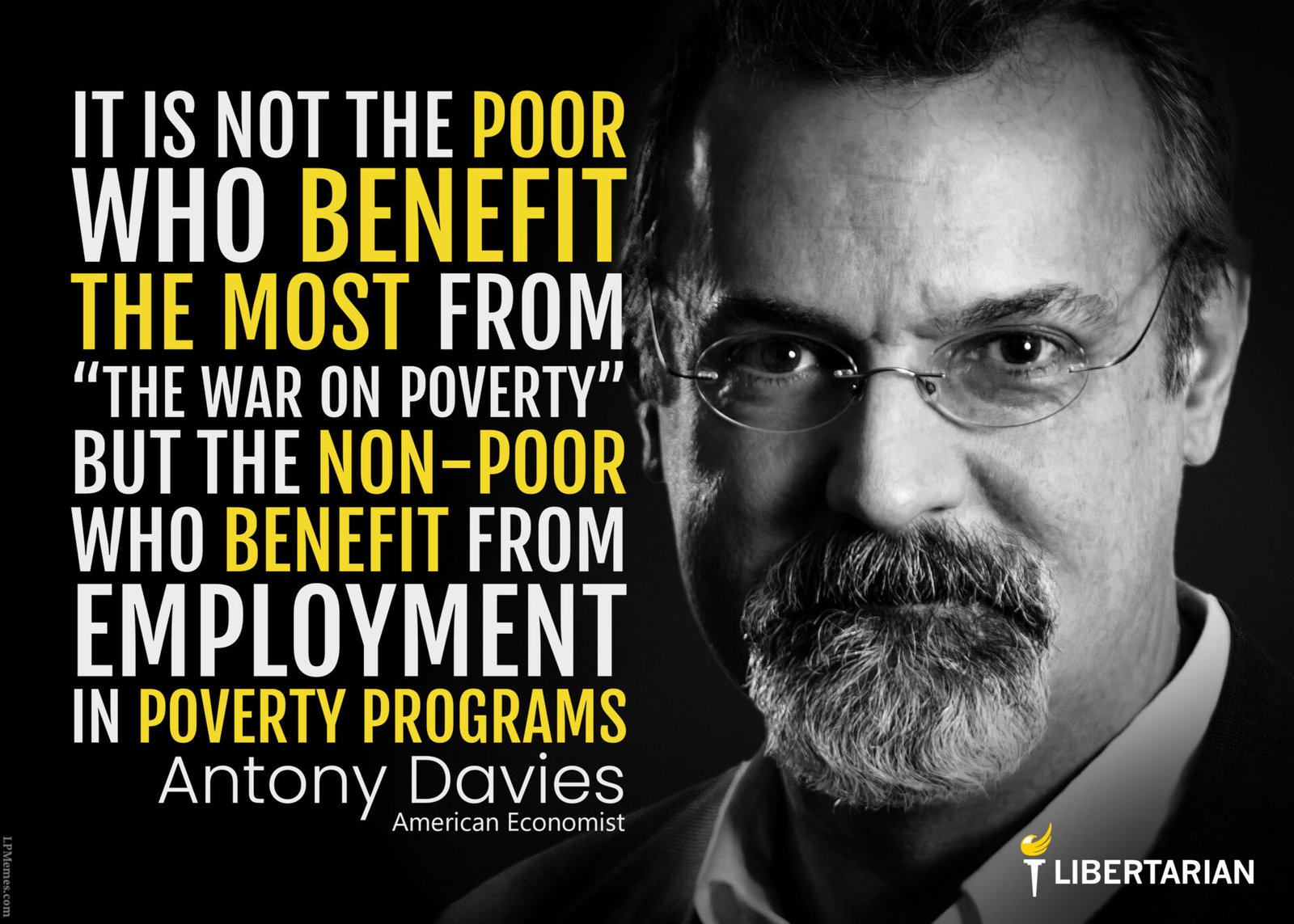
It is not the poor who benefit the most from “the war on poverty” but the non-poor who benefit from employment in poverty programs. —Antony Davies
Normal Quality (1920×1005 240 KB)
It is not the poor who benefit the most from “the war on poverty” but the non-poor who benefit from employment in poverty programs. —Antony Davies
Normal Quality (1920×1372 327 KB)
It is not the poor who benefit the most from “the war on poverty” but the non-poor who benefit from employment in poverty programs. —Antony Davies

It is not the poor who benefit the most from “the war on poverty” but the non-poor who benefit from employment in poverty programs. —Antony Davies

1389: Antony Davies – Poverty Bureaucracy

We have developed a poverty industry and a poverty bureaucracy. Both of them seek to perpetuate themselves, and yet the poverty rate remains the same year over year. The war on poverty is not dominated by the people who are poor but by the non-poor who benefit from employment in poverty programs. —Antony Davies
Normal Quality (3840×2010 102 KB)
We have developed a poverty industry and a poverty bureaucracy. Both of them seek to perpetuate themselves, and yet the poverty rate remains the same year over year. The war on poverty is not dominated by the people who are poor but by the non-poor who benefit from employment in poverty programs. —Antony Davies
Normal Quality (3072×3840 281 KB)
We have developed a poverty industry and a poverty bureaucracy. Both of them seek to perpetuate themselves, and yet the poverty rate remains the same year over year. The war on poverty is not dominated by the people who are poor but by the non-poor who benefit from employment in poverty programs. —Antony Davies

We have developed a poverty industry and a poverty bureaucracy. Both of them seek to perpetuate themselves, and yet the poverty rate remains the same year over year. The war on poverty is not dominated by the people who are poor but by the non-poor who benefit from employment in poverty programs. —Antony Davies

1375: Murray Rothbard – Man Cannot Live as a Parasite

The man who seizes another's property is living in basic contradiction to his own nature as a man. For man can only live and prosper by his own production and exchange of products. The aggressor, on the other hand, is not a producer at all but a predator; he lives parasitically off the labor and product of others. Parasites must have non-parasites to feed upon. The parasite depends completely on the production of the host body. Any increase in coercive exploitation (parasitism) decreases the quantity and the output of the producers, until finally, if the producers die out, the parasites will quickly follow suit. Thus, parasitism cannot be a universal ethic. —Murray Rothbard
Normal Quality (3840×2010 139 KB)
The man who seizes another's property is living in basic contradiction to his own nature as a man. For man can only live and prosper by his own production and exchange of products. The aggressor, on the other hand, is not a producer at all but a predator; he lives parasitically off the labor and product of others. Parasites must have non-parasites to feed upon. The parasite depends completely on the production of the host body. Any increase in coercive exploitation (parasitism) decreases the quantity and the output of the producers, until finally, if the producers die out, the parasites will quickly follow suit. Thus, parasitism cannot be a universal ethic. —Murray Rothbard
Normal Quality (3073×3840 158 KB)
The man who seizes another's property is living in basic contradiction to his own nature as a man. For man can only live and prosper by his own production and exchange of products. The aggressor, on the other hand, is not a producer at all but a predator; he lives parasitically off the labor and product of others. Parasites must have non-parasites to feed upon. The parasite depends completely on the production of the host body. Any increase in coercive exploitation (parasitism) decreases the quantity and the output of the producers, until finally, if the producers die out, the parasites will quickly follow suit. Thus, parasitism cannot be a universal ethic. —Murray Rothbard

The man who seizes another’s property is living in basic contradiction to his own nature as a man. For man can only live and prosper by his own production and exchange of products. The aggressor, on the other hand, is not a producer at all but a predator; he lives parasitically off the labor and product of others. Parasites must have non-parasites to feed upon. The parasite depends completely on the production of the host body. Any increase in coercive exploitation (parasitism) decreases the quantity and the output of the producers, until finally, if the producers die out, the parasites will quickly follow suit. Thus, parasitism cannot be a universal ethic. —Murray Rothbard

1359: Antony Davies – 22 Trillion on Poverty

If the government had simply divided the 22 trillion dollars it spent on poverty since 1964 among all the poor people living in the United States since 1964, each person would've received more than $10,000 per year. —Antony Davies
Normal Quality (3840×2010 89 KB)
If the government had simply divided the 22 trillion dollars it spent on poverty since 1964 among all the poor people living in the United States since 1964, each person would've received more than $10,000 per year. —Antony Davies
Normal Quality (3840×3840 238 KB)
If the government had simply divided the 22 trillion dollars it spent on poverty since 1964 among all the poor people living in the United States since 1964, each person would've received more than $10,000 per year. —Antony Davies

If the government had simply divided the 22 trillion dollars it spent on poverty since 1964 among all the poor people living in the United States since 1964, each person would’ve received more than $10,000 per year. —Antony Davies

1337: Ayn Rand – The Right to Enslave

If some men are entitled by right to the products of the work of others, it means that those others are deprived of rights and condemned to slave labor. No man can have a right to impose an unchosen obligation, an unrewarded duty, or an involuntary servitude on another man. There can be no such thing as “the right to enslave” —Ayn Rand
Normal Quality (3840×2010 92 KB)
If some men are entitled by right to the products of the work of others, it means that those others are deprived of rights and condemned to slave labor. No man can have a right to impose an unchosen obligation, an unrewarded duty, or an involuntary servitude on another man. There can be no such thing as “the right to enslave” —Ayn Rand
Normal Quality (3840×3840 267 KB)
If some men are entitled by right to the products of the work of others, it means that those others are deprived of rights and condemned to slave labor. No man can have a right to impose an unchosen obligation, an unrewarded duty, or an involuntary servitude on another man. There can be no such thing as “the right to enslave” —Ayn Rand

If some men are entitled by right to the products of the work of others, it means that those others are deprived of rights and condemned to slave labor. No man can have a right to impose an unchosen obligation, an unrewarded duty, or an involuntary servitude on another man. There can be no such thing as “the right to enslave” —Ayn Rand

1335: James Madison – Charity is No Part of Government

Charity is no part of the legislative duty of the government. —James Madison
Normal Quality (3840×2010 136 KB)
Charity is no part of the legislative duty of the government. —James Madison
Normal Quality (3840×3840 328 KB)

Charity is no part of the legislative duty of the government. —James Madison

1315: Thomas DiLorenzo – Government Waste

In government, the worse an agency performs, the more money it can claim from a legislature. If state-run schools fail to educate children, then obviously they need more money… If the welfare state fails to reduce, or actually increases, poverty then obviously, say the bureaucrats, we need to expand welfare programs even further. —Thomas DiLorenzo, The Problem with Socialism
Normal Quality (3840×2010 116 KB)
In government, the worse an agency performs, the more money it can claim from a legislature. If state-run schools fail to educate children, then obviously they need more money… If the welfare state fails to reduce, or actually increases, poverty then obviously, say the bureaucrats, we need to expand welfare programs even further. —Thomas DiLorenzo, The Problem with Socialism
Normal Quality (3840×3840 148 KB)
In government, the worse an agency performs, the more money it can claim from a legislature. If state-run schools fail to educate children, then obviously they need more money… If the welfare state fails to reduce, or actually increases, poverty then obviously, say the bureaucrats, we need to expand welfare programs even further. —Thomas DiLorenzo, The Problem with Socialism

In government, the worse an agency performs, the more money it can claim from a legislature. If state-run schools fail to educate children, then obviously they need more money… If the welfare state fails to reduce, or actually increases, poverty then obviously, say the bureaucrats, we need to expand welfare programs even further. —Thomas DiLorenzo, The Problem with Socialism

1301: Tom Woods – Greatest Gains Against Poverty

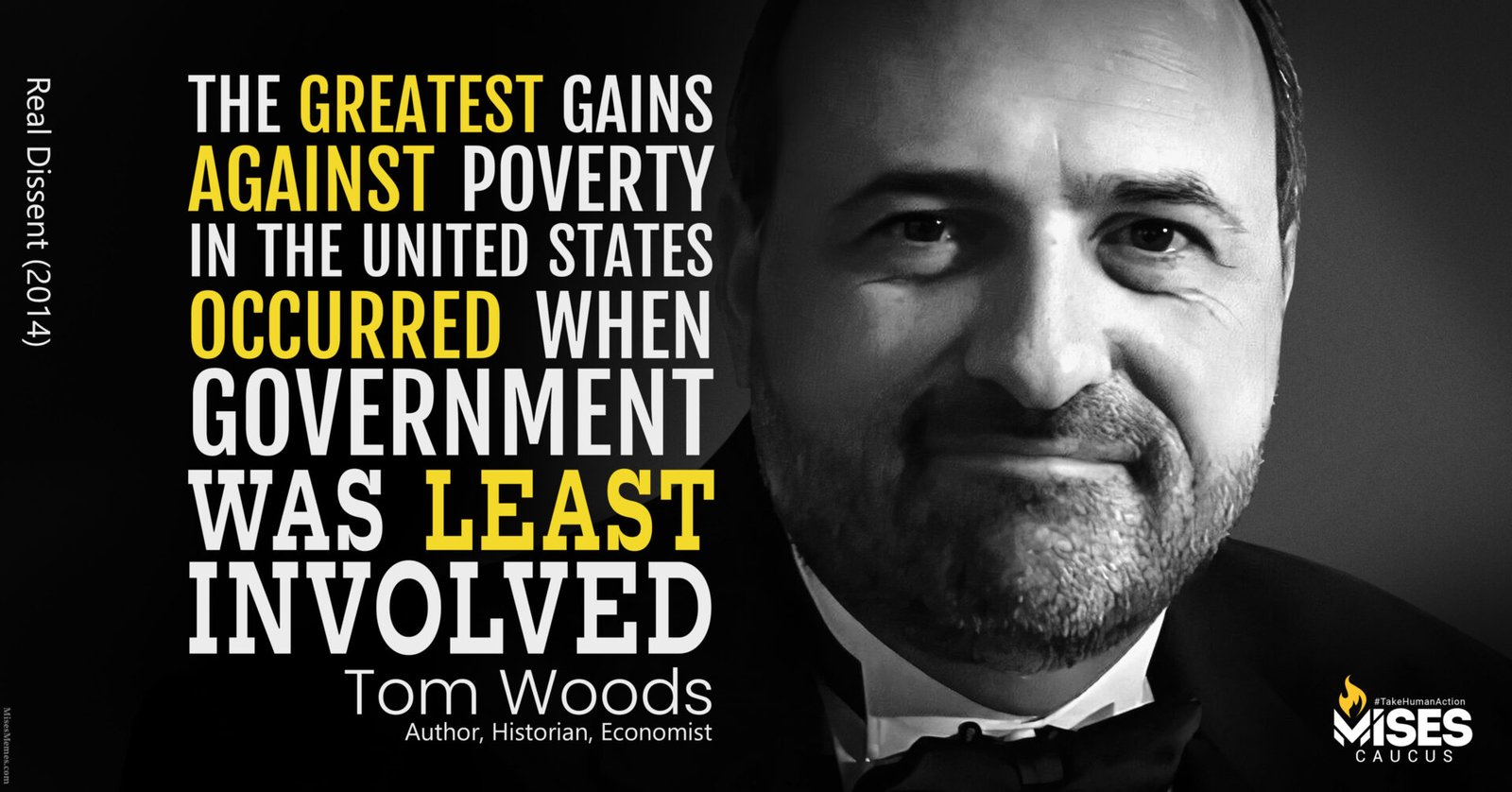
The greatest gains against poverty in the United States occurred when government was least involved. —Tom Woods
Normal Quality (1920×1005 216 KB)
The greatest gains against poverty in the United States occurred when government was least involved. —Tom Woods
Normal Quality (1920×1372 280 KB)
The greatest gains against poverty in the United States occurred when government was least involved. —Tom Woods

The greatest gains against poverty in the United States occurred when government was least involved. —Tom Woods