1446: Ayn Rand – If Capitalism Never Existed

If capitalism had never existed, any honest humanitarian should have been struggling to invent it. But when you see men struggling to evade its existence, to misrepresent its nature, and to destroy its last remnants—you may be sure that whatever their motives, love for man is not one of them. —Ayn Rand
Normal Quality (1920×1005 206 KB)
If capitalism had never existed, any honest humanitarian should have been struggling to invent it. But when you see men struggling to evade its existence, to misrepresent its nature, and to destroy its last remnants—you may be sure that whatever their motives, love for man is not one of them. —Ayn Rand
Normal Quality (1920×1372 251 KB)
If capitalism had never existed, any honest humanitarian should have been struggling to invent it. But when you see men struggling to evade its existence, to misrepresent its nature, and to destroy its last remnants—you may be sure that whatever their motives, love for man is not one of them. —Ayn Rand

If capitalism had never existed, any honest humanitarian should have been struggling to invent it. But when you see men struggling to evade its existence, to misrepresent its nature, and to destroy its last remnants—you may be sure that whatever their motives, love for man is not one of them. —Ayn Rand

1404: Ayn Rand – Statism is Perpetual Violence

Statism is a system of institutionalized violence and perpetual civil war. It leaves men no choice but to fight to seize political power—to rob or be robbed, to kill or be killed. When brute force is the only criterion of social conduct, and unresisting surrender to destruction is the only alternative, even the lowest of men, even an animal—even a cornered rat—will fight. There can be no peace within an enslaved nation. —Ayn Rand
Normal Quality (1920×1005 240 KB)
Statism is a system of institutionalized violence and perpetual civil war. It leaves men no choice but to fight to seize political power—to rob or be robbed, to kill or be killed. When brute force is the only criterion of social conduct, and unresisting surrender to destruction is the only alternative, even the lowest of men, even an animal—even a cornered rat—will fight. There can be no peace within an enslaved nation. —Ayn Rand
Normal Quality (1920×1372 315 KB)
Statism is a system of institutionalized violence and perpetual civil war. It leaves men no choice but to fight to seize political power—to rob or be robbed, to kill or be killed. When brute force is the only criterion of social conduct, and unresisting surrender to destruction is the only alternative, even the lowest of men, even an animal—even a cornered rat—will fight. There can be no peace within an enslaved nation. —Ayn Rand

Statism is a system of institutionalized violence and perpetual civil war. It leaves men no choice but to fight to seize political power—to rob or be robbed, to kill or be killed. When brute force is the only criterion of social conduct, and unresisting surrender to destruction is the only alternative, even the lowest of men, even an animal—even a cornered rat—will fight. There can be no peace within an enslaved nation. —Ayn Rand

1337: Ayn Rand – The Right to Enslave

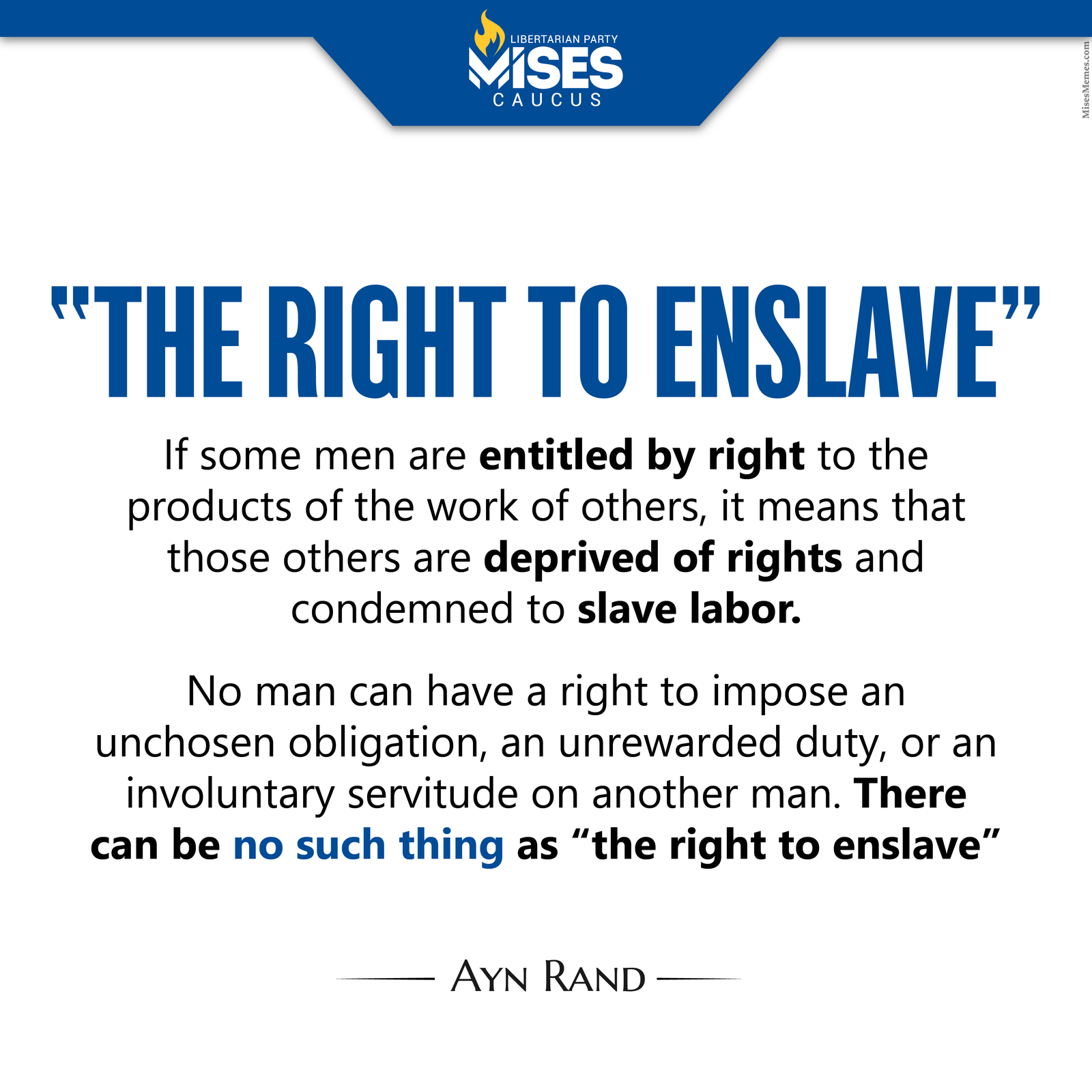
If some men are entitled by right to the products of the work of others, it means that those others are deprived of rights and condemned to slave labor. No man can have a right to impose an unchosen obligation, an unrewarded duty, or an involuntary servitude on another man. There can be no such thing as “the right to enslave” —Ayn Rand
Normal Quality (3840×2010 92 KB)
If some men are entitled by right to the products of the work of others, it means that those others are deprived of rights and condemned to slave labor. No man can have a right to impose an unchosen obligation, an unrewarded duty, or an involuntary servitude on another man. There can be no such thing as “the right to enslave” —Ayn Rand
Normal Quality (3840×3840 267 KB)
If some men are entitled by right to the products of the work of others, it means that those others are deprived of rights and condemned to slave labor. No man can have a right to impose an unchosen obligation, an unrewarded duty, or an involuntary servitude on another man. There can be no such thing as “the right to enslave” —Ayn Rand

If some men are entitled by right to the products of the work of others, it means that those others are deprived of rights and condemned to slave labor. No man can have a right to impose an unchosen obligation, an unrewarded duty, or an involuntary servitude on another man. There can be no such thing as “the right to enslave” —Ayn Rand

1336: Ayn Rand – A Guide to Rights

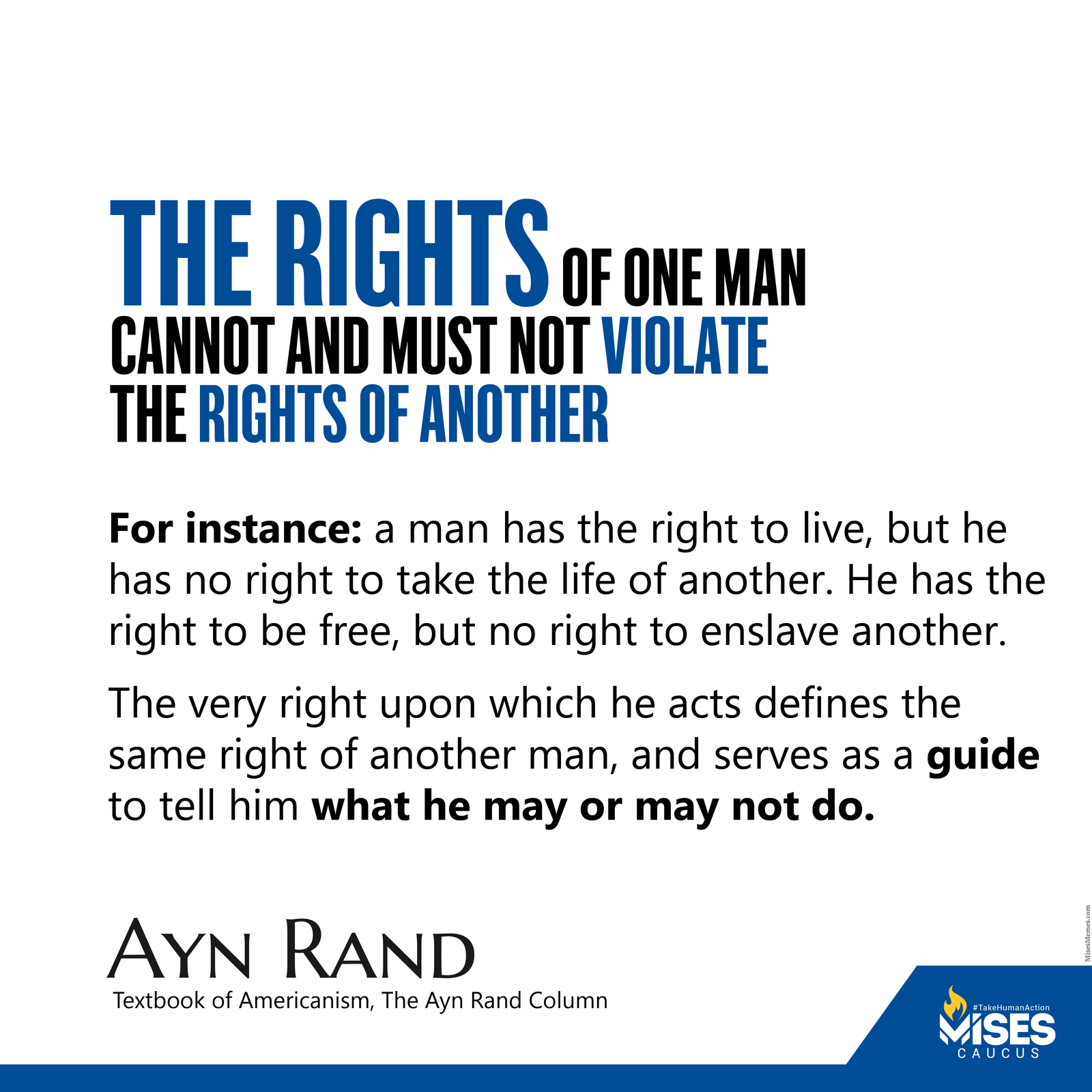
The rights of one man cannot and must not violate the rights of another. For instance: a man has the right to live, but he has no right to take the life of another. He has the right to be free, but no right to enslave another.
The very right upon which he acts defines the same right of another man, and serves as a guide to tell him what he may or may not do. —Ayn Rand
Normal Quality (3840×2010 98 KB)
The rights of one man cannot and must not violate the rights of another. For instance: a man has the right to live, but he has no right to take the life of another. He has the right to be free, but no right to enslave another.
The very right upon which he acts defines the same right of another man, and serves as a guide to tell him what he may or may not do. —Ayn Rand
Normal Quality (3840×3840 141 KB)
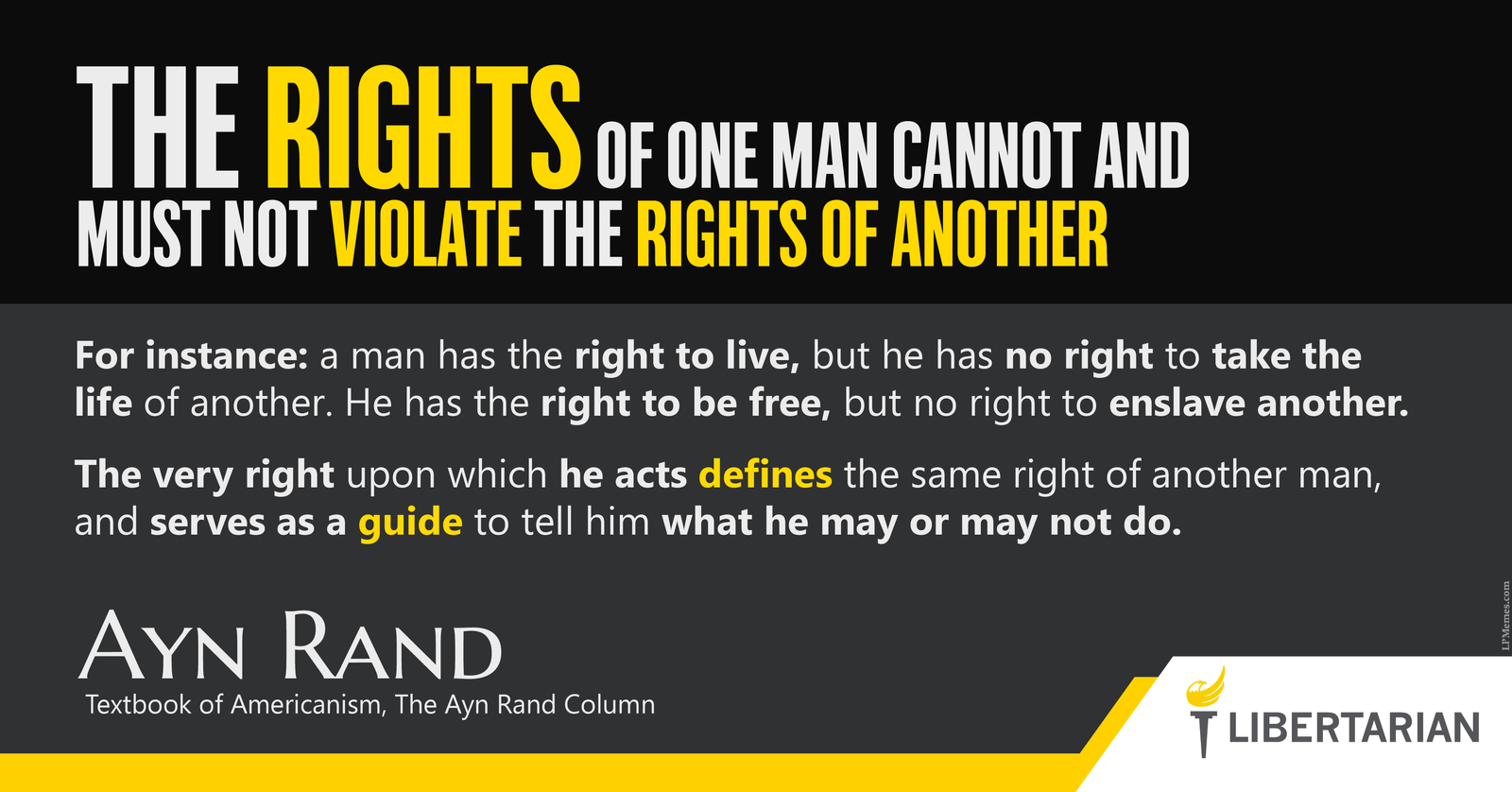
The rights of one man cannot and must not violate the rights of another. For instance: a man has the right to live, but he has no right to take the life of another. He has the right to be free, but no right to enslave another. The very right upon which he acts defines the same right of another man, and serves as a guide to tell him what he may or may not do. —Ayn Rand

The rights of one man cannot and must not violate the rights of another. For instance: a man has the right to live, but he has no right to take the life of another. He has the right to be free, but no right to enslave another.
The very right upon which he acts defines the same right of another man, and serves as a guide to tell him what he may or may not do. —Ayn Rand

1328: Ayn Rand – The Rights of Another

Any alleged right of one man which necessitates the violation of the rights of another is not and cannot be a right. —Ayn Rand, The Virtue of Selfishness (1964)
Normal Quality (1920×1005 174 KB)
Any alleged right of one man which necessitates the violation of the rights of another is not and cannot be a right. —Ayn Rand, The Virtue of Selfishness (1964)
Normal Quality (1920×1372 230 KB)
Any alleged right of one man which necessitates the violation of the rights of another is not and cannot be a right. —Ayn Rand, The Virtue of Selfishness (1964)

Any alleged right of one man which necessitates the violation of the rights of another is not and cannot be a right. —Ayn Rand, The Virtue of Selfishness (1964)

1295: Ayn Rand – Businessmen vs. Bureaucrats

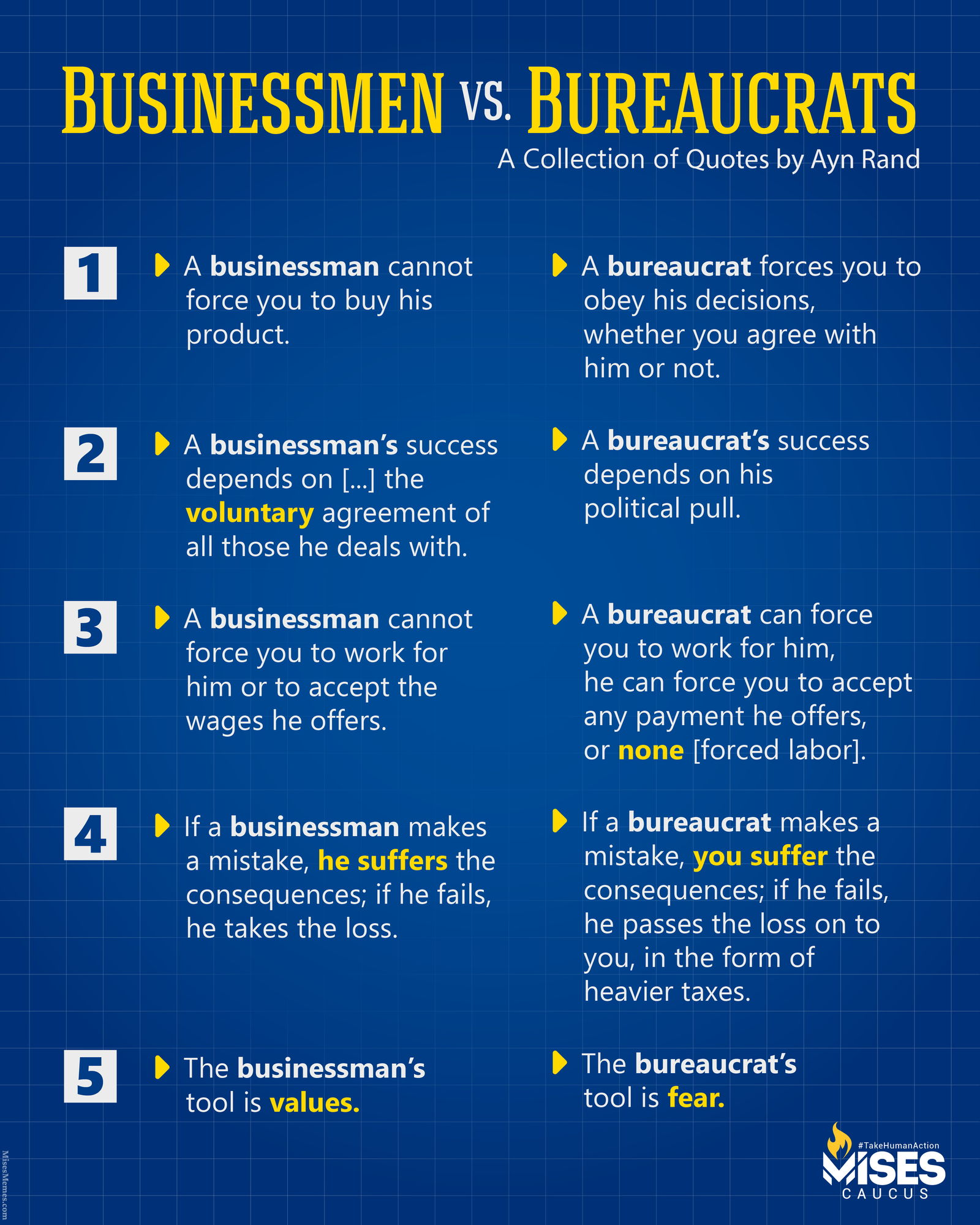
A businessman’s success depends on his intelligence, his knowledge, his productive ability, his economic judgment—and on the voluntary agreement of all those he deals with: his customers, his suppliers, his employees, his creditors or investors. A bureaucrat’s success depends on his political pull. A businessman cannot force you to buy his product; if he makes a mistake, he suffers the consequences; if he fails, he takes the loss. A bureaucrat forces you to obey his decisions, whether you agree with him or not—and the more advanced the stage of a country’s statism, the wider and more discretionary the powers wielded by a bureaucrat. If he makes a mistake, you suffer the consequences; if he fails, he passes the loss on to you, in the form of heavier taxes. —Ayn Rand
Normal Quality (3072×3840 786 KB)
A businessman’s success depends on his intelligence, his knowledge, his productive ability, his economic judgment—and on the voluntary agreement of all those he deals with: his customers, his suppliers, his employees, his creditors or investors. A bureaucrat’s success depends on his political pull. A businessman cannot force you to buy his product; if he makes a mistake, he suffers the consequences; if he fails, he takes the loss. A bureaucrat forces you to obey his decisions, whether you agree with him or not—and the more advanced the stage of a country’s statism, the wider and more discretionary the powers wielded by a bureaucrat. If he makes a mistake, you suffer the consequences; if he fails, he passes the loss on to you, in the form of heavier taxes. —Ayn Rand
Normal Quality (3072×3840 755 KB)

A businessman’s success depends on his intelligence, his knowledge, his productive ability, his economic judgment—and on the voluntary agreement of all those he deals with: his customers, his suppliers, his employees, his creditors or investors. A bureaucrat’s success depends on his political pull. A businessman cannot force you to buy his product; if he makes a mistake, he suffers the consequences; if he fails, he takes the loss. A bureaucrat forces you to obey his decisions, whether you agree with him or not—and the more advanced the stage of a country’s statism, the wider and more discretionary the powers wielded by a bureaucrat. If he makes a mistake, you suffer the consequences; if he fails, he passes the loss on to you, in the form of heavier taxes.

A businessman cannot force you to work for him or to accept the wages he offers; you are free to seek employment elsewhere and to accept a better offer, if you can find it. (Remember, in this context, that jobs do not exist “in nature,” that they do not grow on trees, that someone has to create the job you need, and that that someone, the businessman, will go out of business if he pays you more than the market permits him to pay you.) A bureaucrat can force you to work for him, when he achieves the totalitarian power he seeks; he can force you to accept any payment he offers—or none, as witness the forced labor camps in the countries of full statism.

The businessman’s tool is values; the bureaucrat’s tool is fear.

—Ayn Rand

1174: Ayn Rand – Individual Rights are Not Subject to a Public Vote

A majority has no right to vote away the rights of a minority. Individual Rights are not subject to a public vote. —Ayn Rand
Normal Quality (3840×2010 343 KB)
A majority has no right to vote away the rights of a minority. Individual Rights are not subject to a public vote. —Ayn Rand
Normal Quality (3574×3840 815 KB)

A majority has no right to vote away the rights of a minority. Individual Rights are not subject to a public vote. —Ayn Rand

1154: Ayn Rand – When the Law No Longer Protects You

When the Law no longer protects you from the corrupt, but protects the corrupt from you, you know your nation is doomed. —Ayn Rand
Normal Quality (1920×1005 172 KB)
When the Law no longer protects you from the corrupt, but protects the corrupt from you, you know your nation is doomed. —Ayn Rand
Normal Quality (1920×1372 209 KB)
When the Law no longer protects you from the corrupt, but protects the corrupt from you, you know your nation is doomed. —Ayn Rand

When the Law no longer protects you from the corrupt, but protects the corrupt from you, you know your nation is doomed. —Ayn Rand

1075: Ayn Rand – Statists and Control

One of the methods used by statists to destroy capitalism consists in establishing controls that tie a given industry hand and foot, making it unable to solve its problems, then declaring that freedom has failed and stronger controls are necessary. —Ayn Rand

Normal Quality (1920×1006 189 KB)
One of the methods used by statists to destroy capitalism consists in establishing controls that tie a given industry hand and foot, making it unable to solve its problems, then declaring that freedom has failed and stronger controls are necessary. —Ayn Rand

Normal Quality (1920×1920 257 KB)
One of the methods used by statists to destroy capitalism consists in establishing controls that tie a given industry hand and foot, making it unable to solve its problems, then declaring that freedom has failed and stronger controls are necessary. —Ayn Rand

1048: Ayn Rand – Smallest Minority on Earth

The smallest minority on earth is the individual. Those who deny individual rights cannot claim to be defenders of minorities. —Ayn Rand

Normal Quality (1920×1005 135 KB)
The smallest minority on earth is the individual. Those who deny individual rights cannot claim to be defenders of minorities. —Ayn Rand

Normal Quality (1920×1372 170 KB)
The smallest minority on earth is the individual. Those who deny individual rights cannot claim to be defenders of minorities. —Ayn Rand

The smallest minority on earth is the individual. Those who deny individual rights cannot claim to be defenders of minorities. —Ayn Rand

The smallest minority on earth is the individual. Those who deny individual rights cannot claim to be defenders of minorities. —Ayn Rand