1411: Jack Lloyd – Voting and Individual Consent

Voting cannot be a substitute for individual consent, as voting is forced upon all people whether they agree with having a vote in the first place or not. —Jack Lloyd, The Definitive Guide to Libertarian Voluntaryism
Normal Quality (1920×1005 247 KB)
Voting cannot be a substitute for individual consent, as voting is forced upon all people whether they agree with having a vote in the first place or not. —Jack Lloyd, The Definitive Guide to Libertarian Voluntaryism
Normal Quality (1920×1372 320 KB)
Voting cannot be a substitute for individual consent, as voting is forced upon all people whether they agree with having a vote in the first place or not. —Jack Lloyd, The Definitive Guide to Libertarian Voluntaryism

Voting cannot be a substitute for individual consent, as voting is forced upon all people whether they agree with having a vote in the first place or not. —Jack Lloyd, The Definitive Guide to Libertarian Voluntaryism

1404: Ayn Rand – Statism is Perpetual Violence

Statism is a system of institutionalized violence and perpetual civil war. It leaves men no choice but to fight to seize political power—to rob or be robbed, to kill or be killed. When brute force is the only criterion of social conduct, and unresisting surrender to destruction is the only alternative, even the lowest of men, even an animal—even a cornered rat—will fight. There can be no peace within an enslaved nation. —Ayn Rand
Normal Quality (1920×1005 240 KB)
Statism is a system of institutionalized violence and perpetual civil war. It leaves men no choice but to fight to seize political power—to rob or be robbed, to kill or be killed. When brute force is the only criterion of social conduct, and unresisting surrender to destruction is the only alternative, even the lowest of men, even an animal—even a cornered rat—will fight. There can be no peace within an enslaved nation. —Ayn Rand
Normal Quality (1920×1372 315 KB)
Statism is a system of institutionalized violence and perpetual civil war. It leaves men no choice but to fight to seize political power—to rob or be robbed, to kill or be killed. When brute force is the only criterion of social conduct, and unresisting surrender to destruction is the only alternative, even the lowest of men, even an animal—even a cornered rat—will fight. There can be no peace within an enslaved nation. —Ayn Rand

Statism is a system of institutionalized violence and perpetual civil war. It leaves men no choice but to fight to seize political power—to rob or be robbed, to kill or be killed. When brute force is the only criterion of social conduct, and unresisting surrender to destruction is the only alternative, even the lowest of men, even an animal—even a cornered rat—will fight. There can be no peace within an enslaved nation. —Ayn Rand

1348: Mary Ruwart – We Are Responsible

We defer to authority figures because they are supposed to know more than we do. If a mistake is made, it's easy to lay the blame at their feet. Ultimately, however, we are responsible for choosing the authority figure we defer to. Choosing to defer to one who urges aggression against others still puts the responsibility on us. —Dr. Mary J. Ruwart, Healing Our World
Normal Quality (1920×1005 300 KB)
We defer to authority figures because they are supposed to know more than we do. If a mistake is made, it's easy to lay the blame at their feet. Ultimately, however, we are responsible for choosing the authority figure we defer to. Choosing to defer to one who urges aggression against others still puts the responsibility on us. —Dr. Mary J. Ruwart, Healing Our World
Normal Quality (1920×1372 392 KB)
We defer to authority figures because they are supposed to know more than we do. If a mistake is made, it's easy to lay the blame at their feet. Ultimately, however, we are responsible for choosing the authority figure we defer to. Choosing to defer to one who urges aggression against others still puts the responsibility on us. —Dr. Mary J. Ruwart, Healing Our World

We defer to authority figures because they are supposed to know more than we do. If a mistake is made, it’s easy to lay the blame at their feet. Ultimately, however, we are responsible for choosing the authority figure we defer to. Choosing to defer to one who urges aggression against others still puts the responsibility on us. —Dr. Mary J. Ruwart, Healing Our World

1338: Karl Hess – Protecting Freedom

If our freedom is so fragile that it must be continuously protected by giving it up, then we are in deep trouble. —Karl Hess
Normal Quality (1920×1005 194 KB)
If our freedom is so fragile that it must be continuously protected by giving it up, then we are in deep trouble. —Karl Hess
Normal Quality (1920×1372 261 KB)
If our freedom is so fragile that it must be continuously protected by giving it up, then we are in deep trouble. —Karl Hess

If our freedom is so fragile that it must be continuously protected by giving it up, then we are in deep trouble. —Karl Hess

1317: Melissa Joan Hart – Two-Party System

I want to break away from this two-party system and I think it’s important for people to know that there’s other candidates out there who really toe the line between Democrat and Republican. —Melissa Joan Hart
Normal Quality (1920×1005 216 KB)
I want to break away from this two-party system and I think it’s important for people to know that there’s other candidates out there who really toe the line between Democrat and Republican. —Melissa Joan Hart
Normal Quality (1920×1372 278 KB)
I want to break away from this two-party system and I think it’s important for people to know that there’s other candidates out there who really toe the line between Democrat and Republican. —Melissa Joan Hart

I want to break away from this two-party system and I think it’s important for people to know that there’s other candidates out there who really toe the line between Democrat and Republican. —Melissa Joan Hart

1314: Hans-Hermann Hoppe – Seven Year Old Voters

If the right to vote were expanded to seven year olds, its policies would most definitely reflect the legitimate concerns of children to have adequate and equal access to free french fries, lemonade and videos. —Hans-Hermann Hoppe
Normal Quality (3840×2010 89 KB)
If the right to vote were expanded to seven year olds, its policies would most definitely reflect the legitimate concerns of children to have adequate and equal access to free french fries, lemonade and videos. —Hans-Hermann Hoppe
Normal Quality (3840×3840 111 KB)
If the right to vote were expanded to seven year olds, its policies would most definitely reflect the legitimate concerns of children to have adequate and equal access to free french fries, lemonade and videos. —Hans-Hermann Hoppe

If the right to vote were expanded to seven year olds, its policies would most definitely reflect the legitimate concerns of children to have adequate and equal access to free french fries, lemonade and videos. —Hans-Hermann Hoppe, Democracy the God that Failed

1309: Thomas Sowell – Dangerous and Stupid

It is hard to imagine a more stupid or more dangerous way of making decisions than by putting those decisions in the hands of people who pay no price for being wrong. —Thomas Sowell
Normal Quality (3840×2010 77 KB)
It is hard to imagine a more stupid or more dangerous way of making decisions than by putting those decisions in the hands of people who pay no price for being wrong. —Thomas Sowell
Normal Quality (3840×3840 208 KB)
It is hard to imagine a more stupid or more dangerous way of making decisions than by putting those decisions in the hands of people who pay no price for being wrong. —Thomas Sowell

It is hard to imagine a more stupid or more dangerous way of making decisions than by putting those decisions in the hands of people who pay no price for being wrong. —Thomas Sowell

1307: Karl Hess – Radical and Revolutionary Movements

Both Left and Right are reactionary and authoritarian. That is to say, both are political. They seek only to revise current methods of acquiring and wielding political power. Radical and revolutionary movements seek not to revise but to revoke. The target of revocation should be obvious. The target is politics itself. —Karl Hess (The Death of Politics)
Normal Quality (3840×2010 107 KB)
Both Left and Right are reactionary and authoritarian. That is to say, both are political. They seek only to revise current methods of acquiring and wielding political power. Radical and revolutionary movements seek not to revise but to revoke. The target of revocation should be obvious. The target is politics itself. —Karl Hess (The Death of Politics)
Normal Quality (3840×3840 133 KB)
Both Left and Right are reactionary and authoritarian. That is to say, both are political. They seek only to revise current methods of acquiring and wielding political power. Radical and revolutionary movements seek not to revise but to revoke. The target of revocation should be obvious. The target is politics itself. —Karl Hess (The Death of Politics)

Both Left and Right are reactionary and authoritarian. That is to say, both are political. They seek only to revise current methods of acquiring and wielding political power. Radical and revolutionary movements seek not to revise but to revoke. The target of revocation should be obvious. The target is politics itself. —Karl Hess (The Death of Politics)

1303: Robert Weir – The Whip Itself

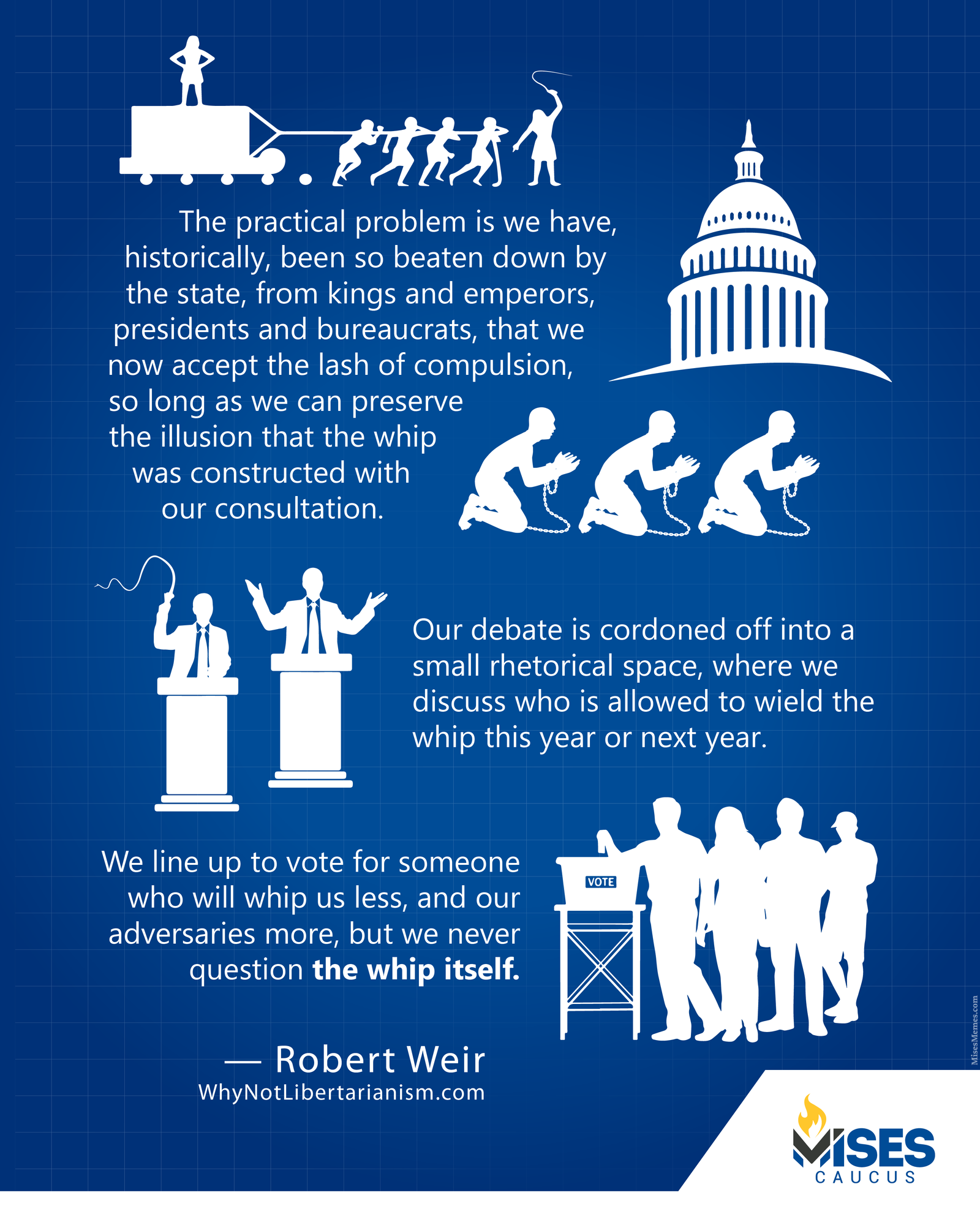
The practical problem is we have, historically, been so beaten down by the state, from kings and emperors, presidents and bureaucrats, that we now accept the lash of compulsion, so long as we can preserve the illusion that the whip was constructed with our consultation. Our debate is cordoned off into a small rhetorical space, where we discuss who is allowed to wield the whip this year or next year. We line up to vote for someone who will whip us less, and our adversaries more, but we never question the whip itself. —Robert Weir (WhyNotLibertarianism.com)
Normal Quality (3072×3840 765 KB)
The practical problem is we have, historically, been so beaten down by the state, from kings and emperors, presidents and bureaucrats, that we now accept the lash of compulsion, so long as we can preserve the illusion that the whip was constructed with our consultation. Our debate is cordoned off into a small rhetorical space, where we discuss who is allowed to wield the whip this year or next year. We line up to vote for someone who will whip us less, and our adversaries more, but we never question the whip itself. —Robert Weir (WhyNotLibertarianism.com)
Normal Quality (3073×3840 694 KB)

The practical problem is we have, historically, been so beaten down by the state, from kings and emperors, presidents and bureaucrats, that we now accept the lash of compulsion, so long as we can preserve the illusion that the whip was constructed with our consultation. Our debate is cordoned off into a small rhetorical space, where we discuss who is allowed to wield the whip this year or next year. We line up to vote for someone who will whip us less, and our adversaries more, but we never question the whip itself. —Robert Weir (WhyNotLibertarianism.com)

1286: Lysander Spooner – Man Refuses to be a Slave

The principle that the majority have a right to rule the minority, practically resolves all government into a mere contest between two bodies of men, as to which of them shall be masters, and which of them slaves; a contest, that-however bloody-can, in the nature of things, never be finally closed, so long as man refuses to be a slave. —Lysander Spooner
Normal Quality (1920×1372 207 KB)
The principle that the majority have a right to rule the minority, practically resolves all government into a mere contest between two bodies of men, as to which of them shall be masters, and which of them slaves; a contest, that-however bloody-can, in the nature of things, never be finally closed, so long as man refuses to be a slave. —Lysander Spooner
Normal Quality (1920×1005 166 KB)
The principle that the majority have a right to rule the minority, practically resolves all government into a mere contest between two bodies of men, as to which of them shall be masters, and which of them slaves; a contest, that-however bloody-can, in the nature of things, never be finally closed, so long as man refuses to be a slave. —Lysander Spooner

The principle that the majority have a right to rule the minority, practically resolves all government into a mere contest between two bodies of men, as to which of them shall be masters, and which of them slaves; a contest, that-however bloody-can, in the nature of things, never be finally closed, so long as man refuses to be a slave. —Lysander Spooner