1442: Ron Paul – The Most Evil of All Taxes

The most sinister of all taxes is inflation. When you create money out of thin air to pay the bills, the value of the dollar goes down, and the poor and the middle class get hit with a higher cost of living. It is the most evil of all taxes. —Ron Paul
Download Print Quality (3840×2010 2 MB)  |  Normal Quality (1920×1005 210 KB)
The most sinister of all taxes is inflation. When you create money out of thin air to pay the bills, the value of the dollar goes down, and the poor and the middle class get hit with a higher cost of living. It is the most evil of all taxes. —Ron Paul
Download Print Quality (3840×2743 3 MB)  |  Normal Quality (1920×1372 272 KB)
The most sinister of all taxes is inflation. When you create money out of thin air to pay the bills, the value of the dollar goes down, and the poor and the middle class get hit with a higher cost of living. It is the most evil of all taxes. —Ron Paul

The most sinister of all taxes is inflation. When you create money out of thin air to pay the bills, the value of the dollar goes down, and the poor and the middle class get hit with a higher cost of living. It is the most evil of all taxes. —Ron Paul

1434: Walter Block – A Tax-Collecting Government

...to argue that a tax-collecting government can legitimately protect its citizens against aggression is to contradict oneself, since such an entity starts off the entire process by doing the very opposite of protecting those under its control. —Walter Block
Normal Quality (1920×1005 284 KB)
...to argue that a tax-collecting government can legitimately protect its citizens against aggression is to contradict oneself, since such an entity starts off the entire process by doing the very opposite of protecting those under its control. —Walter Block
Normal Quality (1920×1372 380 KB)
...to argue that a tax-collecting government can legitimately protect its citizens against aggression is to contradict oneself, since such an entity starts off the entire process by doing the very opposite of protecting those under its control. —Walter Block

…to argue that a tax-collecting government can legitimately protect its citizens against aggression is to contradict oneself, since such an entity starts off the entire process by doing the very opposite of protecting those under its control. —Walter Block

1427: Lysander Spooner – Money in the Hands of Government

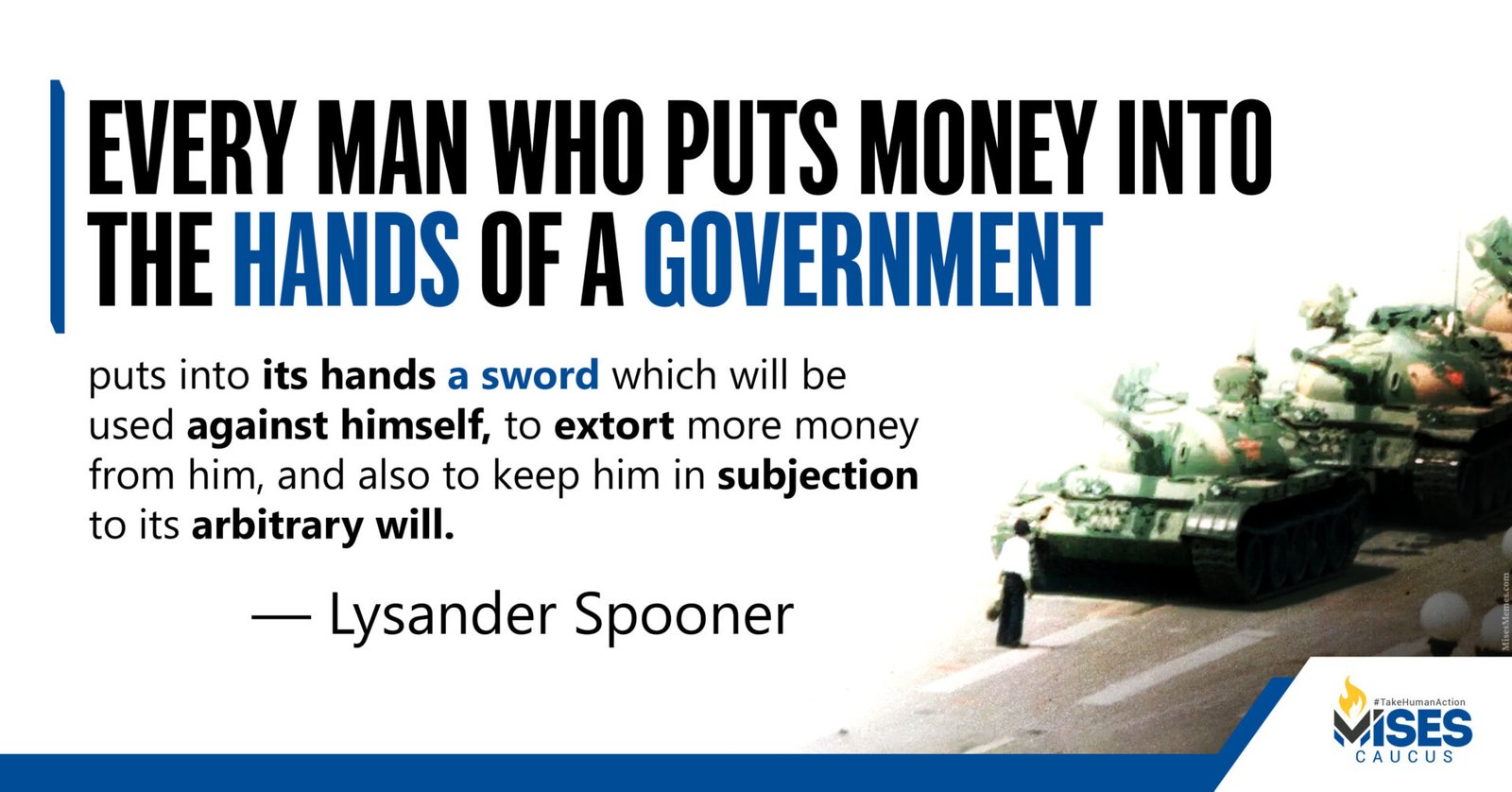
Every man who puts money into the hands of a "government," puts into its hands a sword which will be used against himself, to extort more money from him, and also to keep him in subjection to its arbitrary will. —Lysander Spooner
Normal Quality (1920×1005 198 KB)
Every man who puts money into the hands of a "government," puts into its hands a sword which will be used against himself, to extort more money from him, and also to keep him in subjection to its arbitrary will. —Lysander Spooner
Normal Quality (1920×1372 256 KB)
Every man who puts money into the hands of a "government," puts into its hands a sword which will be used against himself, to extort more money from him, and also to keep him in subjection to its arbitrary will. —Lysander Spooner

Every man who puts money into the hands of a “government,” puts into its hands a sword which will be used against himself, to extort more money from him, and also to keep him in subjection to its arbitrary will. —Lysander Spooner

1421: Lysander Spooner – Government and the Robber

The robber does not pretend to be anything but a robber. Furthermore, having taken your money, he leaves you, as you wish him to do. He does not persist in following you on the road, against your will; assuming to be your rightful "sovereign," on account of the "protection" he affords you.

He does not keep "protecting" you, by commanding you to bow down and serve him; by requiring you to do this, and forbidding you to do that; by robbing you of more money as often as he finds it for his interest or pleasure to do so; and by branding you as a rebel, a traitor, and an enemy to your country, and shooting you down without mercy, if you dispute his authority, or resist his demands. —Lysander Spooner
Download Print Quality (3840×2010 222 KB)  |  Normal Quality (3840×2010 125 KB)
The robber does not pretend to be anything but a robber. Furthermore, having taken your money, he leaves you, as you wish him to do. He does not persist in following you on the road, against your will; assuming to be your rightful "sovereign," on account of the "protection" he affords you.

He does not keep "protecting" you, by commanding you to bow down and serve him; by requiring you to do this, and forbidding you to do that; by robbing you of more money as often as he finds it for his interest or pleasure to do so; and by branding you as a rebel, a traitor, and an enemy to your country, and shooting you down without mercy, if you dispute his authority, or resist his demands. —Lysander Spooner
Download Print Quality (3073×3840 293 KB)  |  Normal Quality (3073×3840 162 KB)
The robber does not pretend to be anything but a robber. Furthermore, having taken your money, he leaves you, as you wish him to do. He does not persist in following you on the road, against your will; assuming to be your rightful "sovereign," on account of the "protection" he affords you.

He does not keep "protecting" you, by commanding you to bow down and serve him; by requiring you to do this, and forbidding you to do that; by robbing you of more money as often as he finds it for his interest or pleasure to do so; and by branding you as a rebel, a traitor, and an enemy to your country, and shooting you down without mercy, if you dispute his authority, or resist his demands. —Lysander Spooner

The robber does not pretend to be anything but a robber. Furthermore, having taken your money, he leaves you, as you wish him to do. He does not persist in following you on the road, against your will; assuming to be your rightful “sovereign,” on account of the “protection” he affords you.

He does not keep “protecting” you, by commanding you to bow down and serve him; by requiring you to do this, and forbidding you to do that; by robbing you of more money as often as he finds it for his interest or pleasure to do so; and by branding you as a rebel, a traitor, and an enemy to your country, and shooting you down without mercy, if you dispute his authority, or resist his demands. —Lysander Spooner

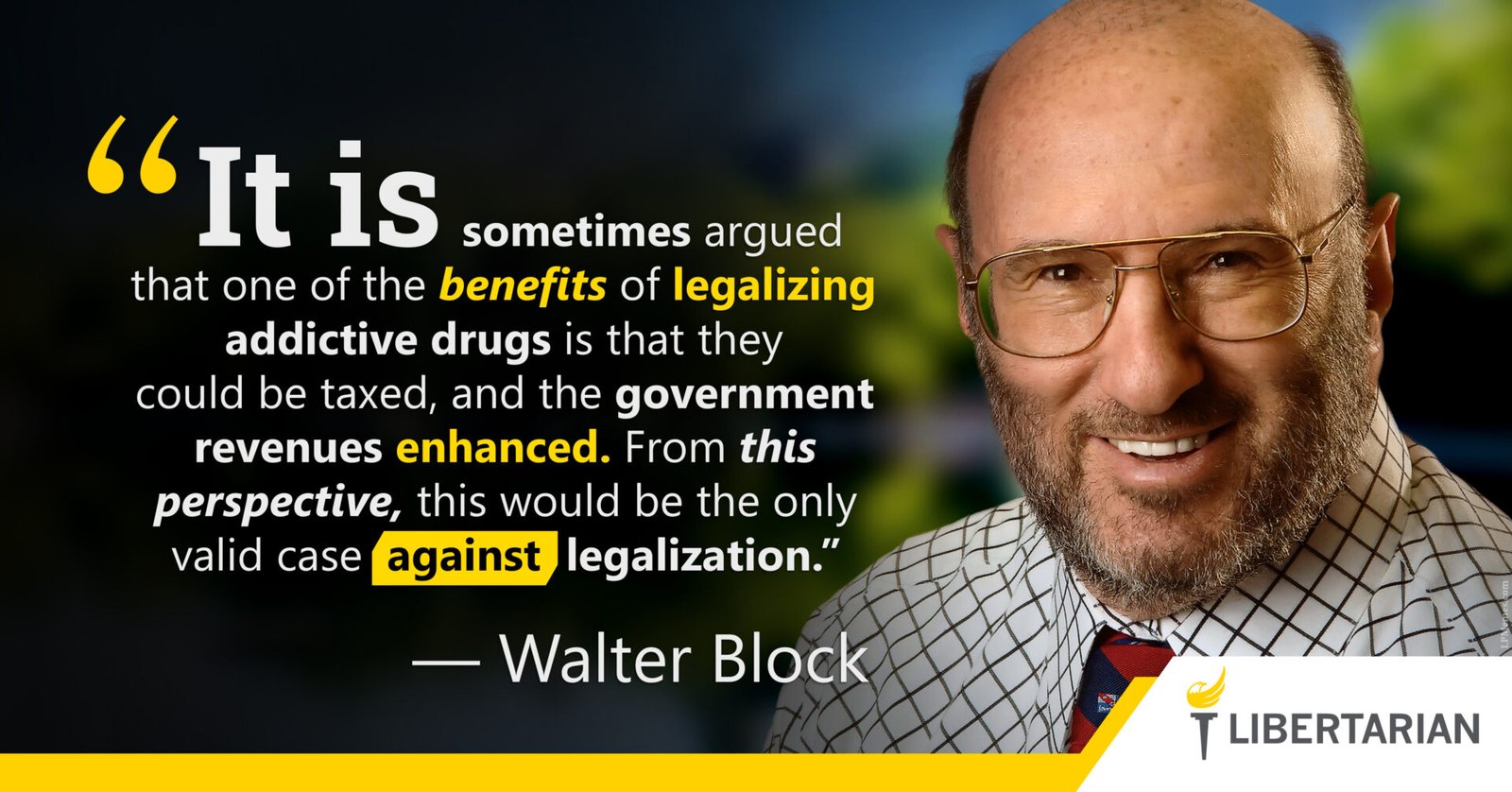
1373: Walter Block – Against Legalizing Drugs

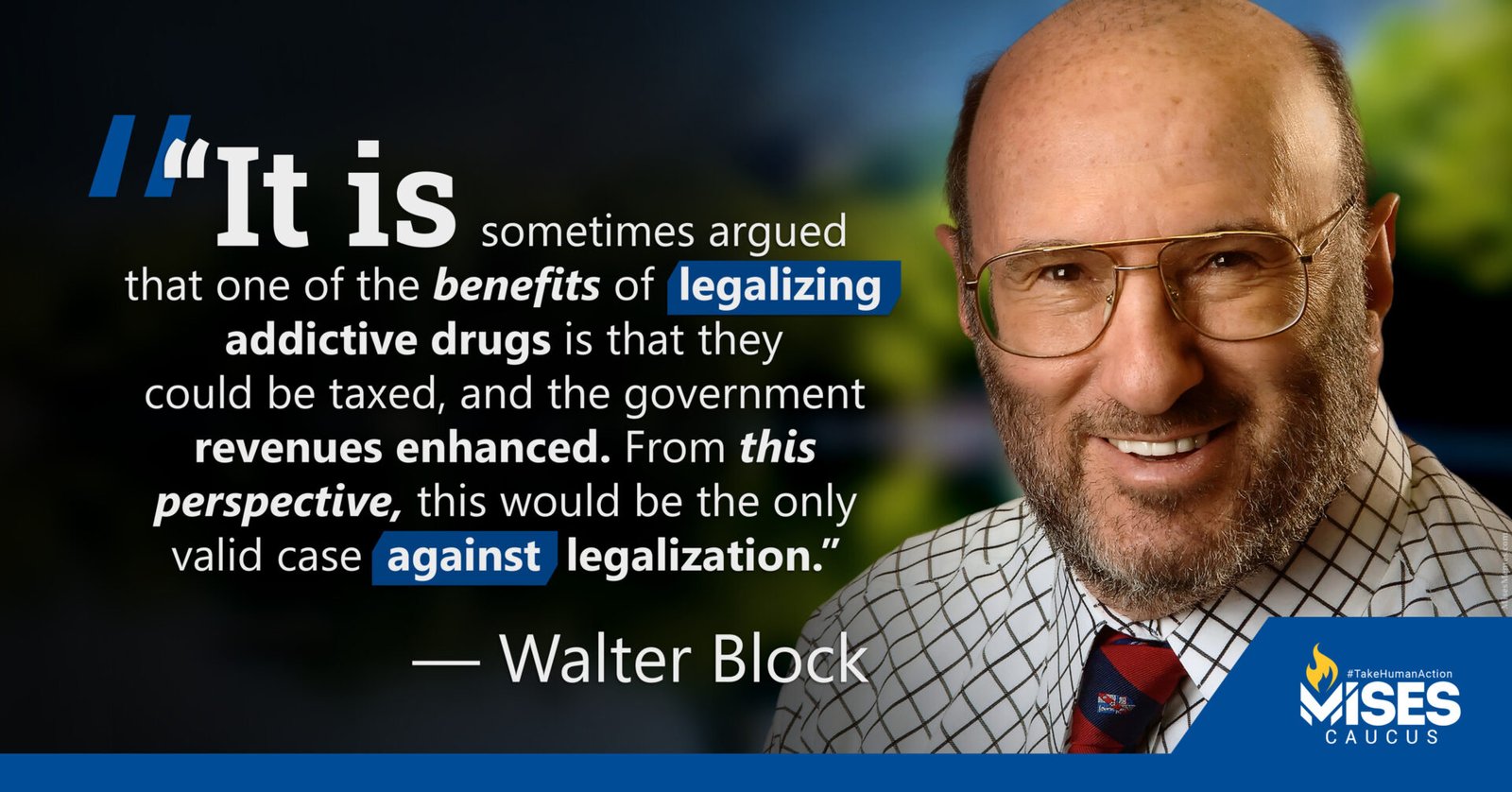
It is sometimes argued that one of the benefits of legalizing addictive drugs is that they could be taxed, and the government revenues enhanced. From this perspective, this would be the only valid case against legalization. —Walter Block
Normal Quality (1920×1005 277 KB)
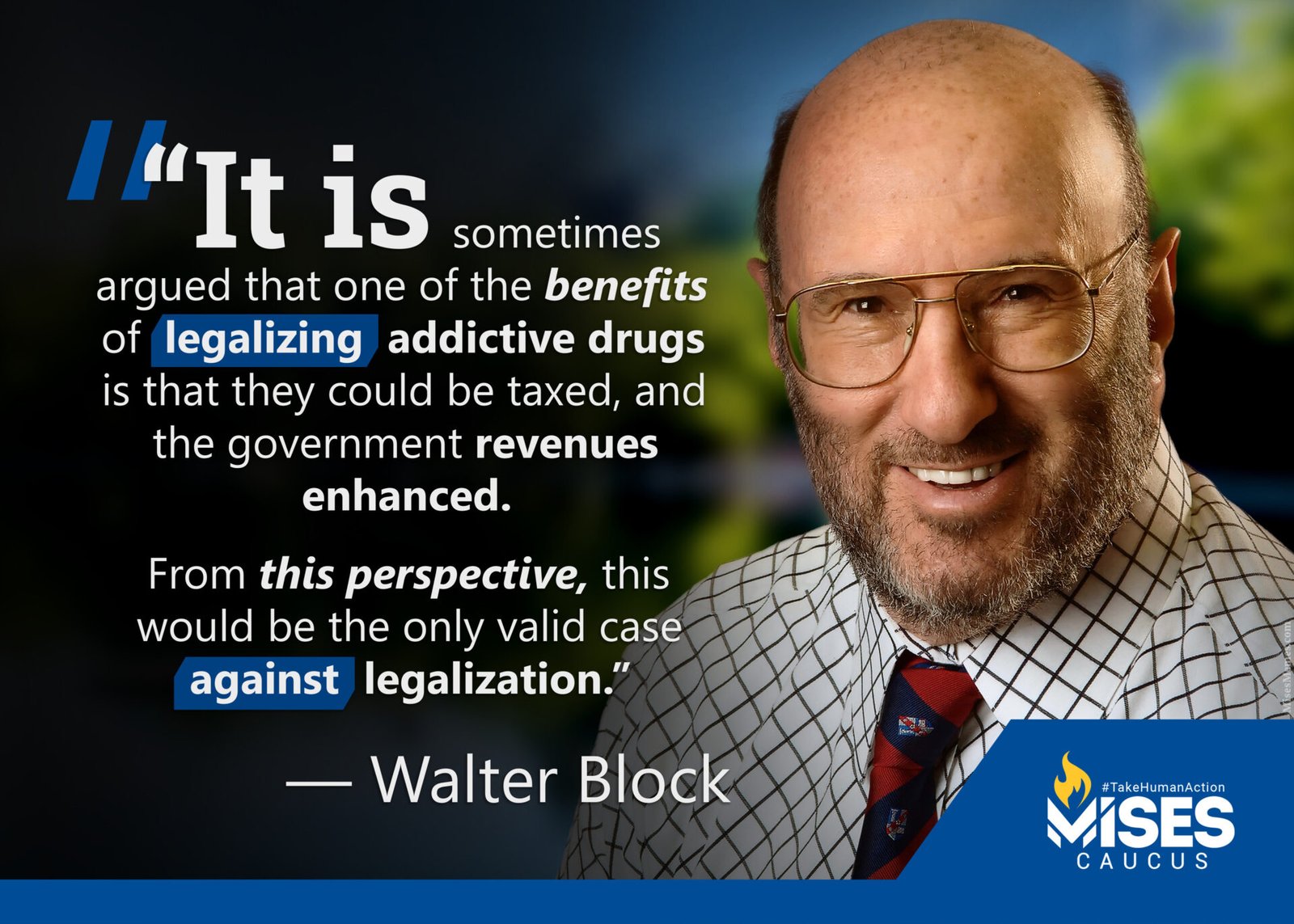
It is sometimes argued that one of the benefits of legalizing addictive drugs is that they could be taxed, and the government revenues enhanced. From this perspective, this would be the only valid case against legalization. —Walter Block
Normal Quality (1920×1372 371 KB)
It is sometimes argued that one of the benefits of legalizing addictive drugs is that they could be taxed, and the government revenues enhanced. From this perspective, this would be the only valid case against legalization. —Walter Block

It is sometimes argued that one of the benefits of legalizing addictive drugs is that they could be taxed, and the government revenues enhanced. From this perspective, this would be the only valid case against legalization. —Walter Block

1339: Thomas DiLorenzo – Working Just to Pay Taxes

Governments confiscate more than a third of all family income. Each year the average American taxpayer works 127 days, from January 1st until May 7th — just to pay taxes. —Thomas DiLorenzo
Download Print Quality (3840×2010 445 KB)  |  Normal Quality (1920×1005 152 KB)
Governments confiscate more than a third of all family income. Each year the average American taxpayer works 127 days, from January 1st until May 7th — just to pay taxes. —Thomas DiLorenzo
Normal Quality (1536×1920 291 KB)
Governments confiscate more than a third of all family income. Each year the average American taxpayer works 127 days, from January 1st until May 7th — just to pay taxes. —Thomas DiLorenzo

Governments confiscate more than a third of all family income. Each year the average American taxpayer works 127 days, from January 1st until May 7th — just to pay taxes. —Thomas DiLorenzo

1335: James Madison – Charity is No Part of Government

Charity is no part of the legislative duty of the government. —James Madison
Normal Quality (3840×2010 136 KB)
Charity is no part of the legislative duty of the government. —James Madison
Normal Quality (3840×3840 328 KB)

Charity is no part of the legislative duty of the government. —James Madison

1296: Walter Williams – False Charity

The act of reaching into one’s own pockets to help a fellow man in need is praiseworthy and laudable. Reaching into someone else’s pocket is despicable. —Walter Williams
Normal Quality (1920×1005 273 KB)
The act of reaching into one’s own pockets to help a fellow man in need is praiseworthy and laudable. Reaching into someone else’s pocket is despicable. —Walter Williams
Normal Quality (1920×1372 369 KB)
The act of reaching into one’s own pockets to help a fellow man in need is praiseworthy and laudable. Reaching into someone else’s pocket is despicable. —Walter Williams

The act of reaching into one’s own pockets to help a fellow man in need is praiseworthy and laudable. Reaching into someone else’s pocket is despicable. —Walter Williams

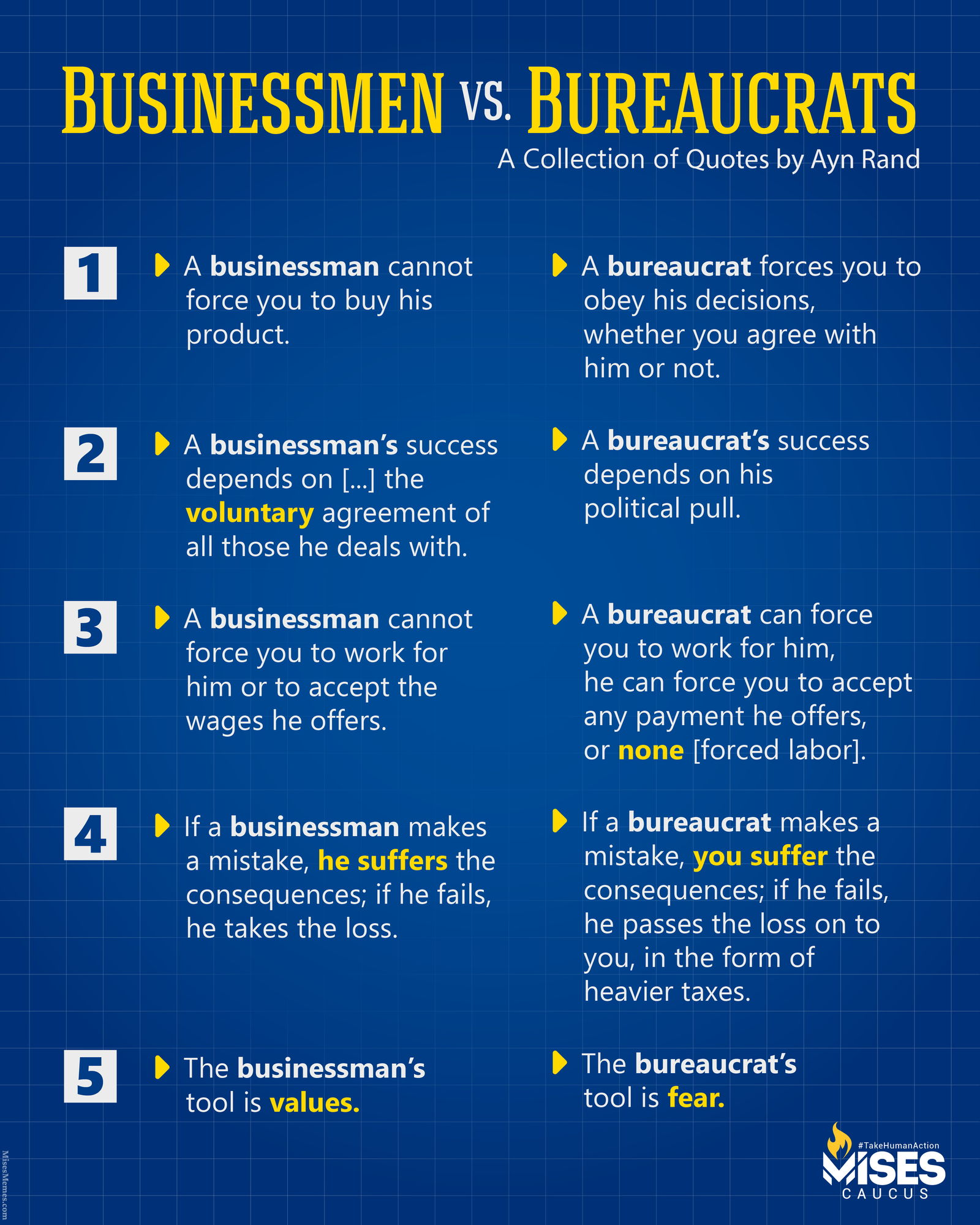
1295: Ayn Rand – Businessmen vs. Bureaucrats

A businessman’s success depends on his intelligence, his knowledge, his productive ability, his economic judgment—and on the voluntary agreement of all those he deals with: his customers, his suppliers, his employees, his creditors or investors. A bureaucrat’s success depends on his political pull. A businessman cannot force you to buy his product; if he makes a mistake, he suffers the consequences; if he fails, he takes the loss. A bureaucrat forces you to obey his decisions, whether you agree with him or not—and the more advanced the stage of a country’s statism, the wider and more discretionary the powers wielded by a bureaucrat. If he makes a mistake, you suffer the consequences; if he fails, he passes the loss on to you, in the form of heavier taxes. —Ayn Rand
Normal Quality (3072×3840 786 KB)
A businessman’s success depends on his intelligence, his knowledge, his productive ability, his economic judgment—and on the voluntary agreement of all those he deals with: his customers, his suppliers, his employees, his creditors or investors. A bureaucrat’s success depends on his political pull. A businessman cannot force you to buy his product; if he makes a mistake, he suffers the consequences; if he fails, he takes the loss. A bureaucrat forces you to obey his decisions, whether you agree with him or not—and the more advanced the stage of a country’s statism, the wider and more discretionary the powers wielded by a bureaucrat. If he makes a mistake, you suffer the consequences; if he fails, he passes the loss on to you, in the form of heavier taxes. —Ayn Rand
Normal Quality (3072×3840 755 KB)

A businessman’s success depends on his intelligence, his knowledge, his productive ability, his economic judgment—and on the voluntary agreement of all those he deals with: his customers, his suppliers, his employees, his creditors or investors. A bureaucrat’s success depends on his political pull. A businessman cannot force you to buy his product; if he makes a mistake, he suffers the consequences; if he fails, he takes the loss. A bureaucrat forces you to obey his decisions, whether you agree with him or not—and the more advanced the stage of a country’s statism, the wider and more discretionary the powers wielded by a bureaucrat. If he makes a mistake, you suffer the consequences; if he fails, he passes the loss on to you, in the form of heavier taxes.

A businessman cannot force you to work for him or to accept the wages he offers; you are free to seek employment elsewhere and to accept a better offer, if you can find it. (Remember, in this context, that jobs do not exist “in nature,” that they do not grow on trees, that someone has to create the job you need, and that that someone, the businessman, will go out of business if he pays you more than the market permits him to pay you.) A bureaucrat can force you to work for him, when he achieves the totalitarian power he seeks; he can force you to accept any payment he offers—or none, as witness the forced labor camps in the countries of full statism.

The businessman’s tool is values; the bureaucrat’s tool is fear.

—Ayn Rand

1290: Ludwig von Mises – The Essential Feature of Government

The funds that a government spends for whatever purposes are levied by taxation. And taxes are paid because the taxpayers are afraid of offering resistance to the tax gatherers. They know that any disobedience or resistance is hopeless. As long as this is the state of affairs, the government is able to collect the money that it wants to spend. Government is in the last resort the employment of armed men, of policemen, gendarmes, soldiers, prison guards, and hangmen. The essential feature of government is the enforcement of its decrees by beating, killing, and imprisoning. Those who are asking for more government interference are asking ultimately for more compulsion and less freedom. —Ludwig von Mises
Normal Quality (2770×3840 903 KB)

The funds that a government spends for whatever purposes are levied by taxation. And taxes are paid because the taxpayers are afraid of offering resistance to the tax gatherers. They know that any disobedience or resistance is hopeless. As long as this is the state of affairs, the government is able to collect the money that it wants to spend. Government is in the last resort the employment of armed men, of policemen, gendarmes, soldiers, prison guards, and hangmen. The essential feature of government is the enforcement of its decrees by beating, killing, and imprisoning. Those who are asking for more government interference are asking ultimately for more compulsion and less freedom. —Ludwig von Mises