1386: Thomas Sowell – Pay is Not a Reward for Merit

People born into families with every advantage of wealth, education, and social position may be able to achieve a high level of productivity without any great struggle that would indicate individual merit. Conversely, people who have had to struggle to overcome many disadvantages, in order to achieve even a modest level of productivity, may show great individual merit. But an economy is not a moral seminar authorized to hand out badges of merit to deserving people. An economy is a mechanism for generating the material wealth on which the standard of living of millions of people depend. Pay is not a retrospective reward for merit but an incentive for contributing to production. —Thomas Sowell
Normal Quality (3840×2010 142 KB)
People born into families with every advantage of wealth, education, and social position may be able to achieve a high level of productivity without any great struggle that would indicate individual merit. Conversely, people who have had to struggle to overcome many disadvantages, in order to achieve even a modest level of productivity, may show great individual merit. But an economy is not a moral seminar authorized to hand out badges of merit to deserving people. An economy is a mechanism for generating the material wealth on which the standard of living of millions of people depend. Pay is not a retrospective reward for merit but an incentive for contributing to production. —Thomas Sowell
Normal Quality (3073×3840 175 KB)
People born into families with every advantage of wealth, education, and social position may be able to achieve a high level of productivity without any great struggle that would indicate individual merit. Conversely, people who have had to struggle to overcome many disadvantages, in order to achieve even a modest level of productivity, may show great individual merit. But an economy is not a moral seminar authorized to hand out badges of merit to deserving people. An economy is a mechanism for generating the material wealth on which the standard of living of millions of people depend. Pay is not a retrospective reward for merit but an incentive for contributing to production. —Thomas Sowell

People born into families with every advantage of wealth, education, and social position may be able to achieve a high level of productivity without any great struggle that would indicate individual merit. Conversely, people who have had to struggle to overcome many disadvantages, in order to achieve even a modest level of productivity, may show great individual merit. But an economy is not a moral seminar authorized to hand out badges of merit to deserving people. An economy is a mechanism for generating the material wealth on which the standard of living of millions of people depend. Pay is not a retrospective reward for merit but an incentive for contributing to production. —Thomas Sowell

1383: Thomas Sowell – Why Women Earn Less

As far back as 1969, academic women who never married earned more than academic men who never married. A study from 2005 showed that among college-educated, never-married individuals with no children who worked full-time and were from 40 to 64 years old—that is, beyond the child-bearing years—men averaged $40,000 a year in income, while women averaged $47,000. The most important reason why women earn less than men is not that they are paid less for doing the very same work but that they are distributed differently among jobs and have fewer hours and less continuity in the labor force. —Thomas Sowell
Normal Quality (3840×2010 128 KB)
As far back as 1969, academic women who never married earned more than academic men who never married. A study from 2005 showed that among college-educated, never-married individuals with no children who worked full-time and were from 40 to 64 years old—that is, beyond the child-bearing years—men averaged $40,000 a year in income, while women averaged $47,000. The most important reason why women earn less than men is not that they are paid less for doing the very same work but that they are distributed differently among jobs and have fewer hours and less continuity in the labor force. —Thomas Sowell
Normal Quality (3840×3840 334 KB)
As far back as 1969, academic women who never married earned more than academic men who never married. A study from 2005 showed that among college-educated, never-married individuals with no children who worked full-time and were from 40 to 64 years old—that is, beyond the child-bearing years—men averaged $40,000 a year in income, while women averaged $47,000. The most important reason why women earn less than men is not that they are paid less for doing the very same work but that they are distributed differently among jobs and have fewer hours and less continuity in the labor force. —Thomas Sowell

As far back as 1969, academic women who never married earned more than academic men who never married. A study from 2005 showed that among college-educated, never-married individuals with no children who worked full-time and were from 40 to 64 years old—that is, beyond the child-bearing years—men averaged $40,000 a year in income, while women averaged $47,000. The most important reason why women earn less than men is not that they are paid less for doing the very same work but that they are distributed differently among jobs and have fewer hours and less continuity in the labor force. —Thomas Sowell

1381: Thomas Sowell – Income Differences Between the Sexes

Although physical strength is no longer as major a factor as it once was, there are still particular industries today where considerable physical strength remains a requirement. —Thomas Sowell
Normal Quality (3072×3840 806 KB)
Although physical strength is no longer as major a factor as it once was, there are still particular industries today where considerable physical strength remains a requirement. —Thomas Sowell
Normal Quality (3072×3840 827 KB)

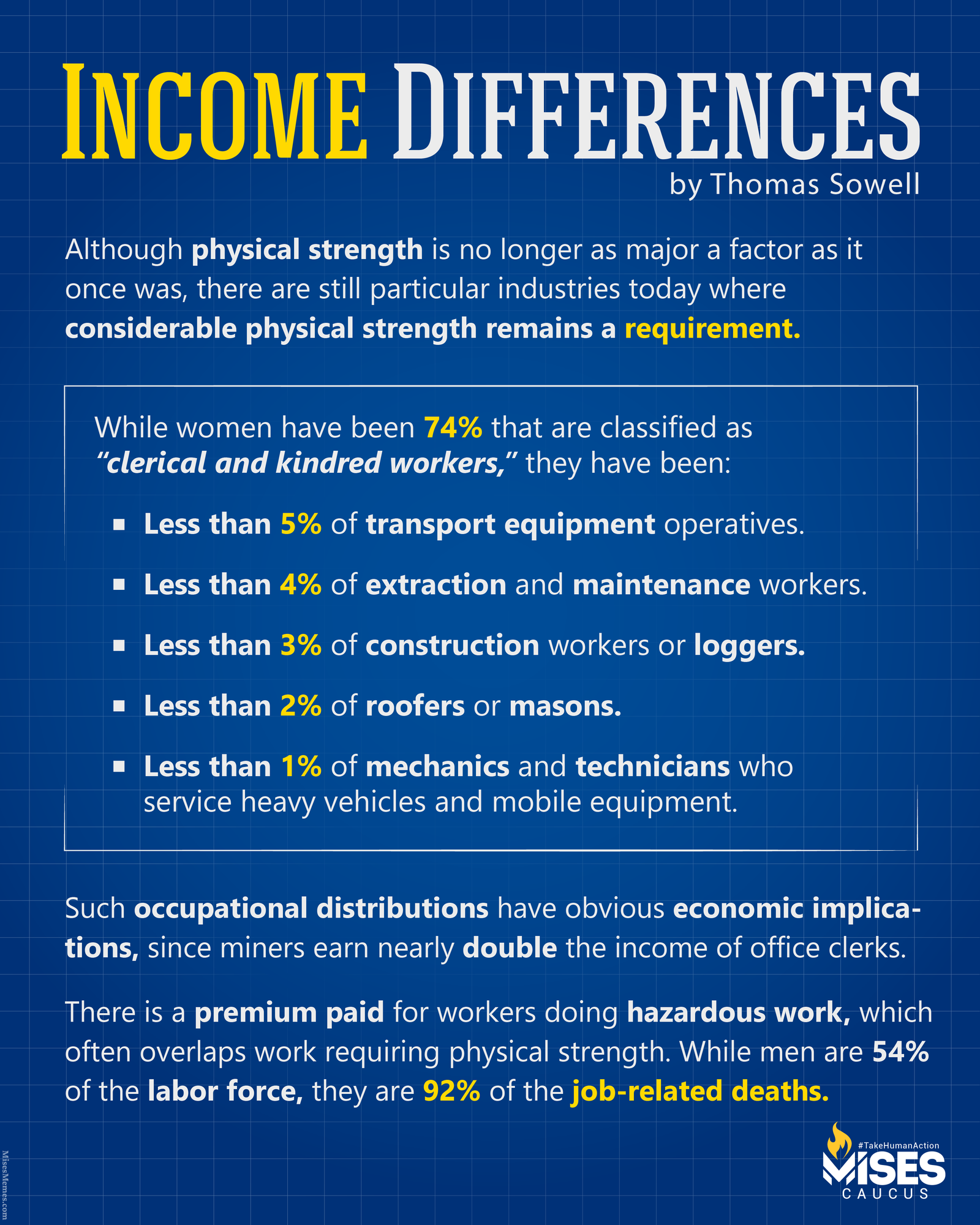
Although physical strength is no longer as major a factor as it once was, there are still particular industries today where considerable physical strength remains a requirement. While women have been 74% that are classified as “clerical and kindred workers,” they have been:

Less than 5% of transport equipment operatives.

Less than 4% of extraction and maintenance workers.

Less than 3% of construction workers or loggers.

Less than 2% of roofers or masons.

Less than 1% of mechanics and technicians who service heavy vehicles and mobile equipment.

Such occupational distributions have obvious economic implications, since miners earn nearly double the income of office clerks. There is a premium paid for workers doing hazardous work, which often overlaps work requiring physical strength. While men are 54% of the labor force, they are 92% of the job-related deaths.

—Thomas Sowell

1380: Thomas Sowell – Women & Higher Education

Women in most countries are going on to higher education in numbers comparable to men—and, in some countries, more often than men. In Japan there are 90 women enrolled in higher education for every 100 men, in the United States 140 women for every 100 men and, in Sweden, 150 women for every 100 men. There is no question that the sexes have often been treated differently [with regards to education]. But few societies today have such severe restrictions on the education of girls, at least not in the Western world. —Thomas Sowell
Normal Quality (3840×2010 119 KB)
Women in most countries are going on to higher education in numbers comparable to men—and, in some countries, more often than men. In Japan there are 90 women enrolled in higher education for every 100 men, in the United States 140 women for every 100 men and, in Sweden, 150 women for every 100 men. There is no question that the sexes have often been treated differently [with regards to education]. But few societies today have such severe restrictions on the education of girls, at least not in the Western world. —Thomas Sowell
Normal Quality (3840×3840 300 KB)
Women in most countries are going on to higher education in numbers comparable to men—and, in some countries, more often than men. In Japan there are 90 women enrolled in higher education for every 100 men, in the United States 140 women for every 100 men and, in Sweden, 150 women for every 100 men. There is no question that the sexes have often been treated differently [with regards to education]. But few societies today have such severe restrictions on the education of girls, at least not in the Western world. —Thomas Sowell

Women in most countries are going on to higher education in numbers comparable to men—and, in some countries, more often than men. In Japan there are 90 women enrolled in higher education for every 100 men, in the United States 140 women for every 100 men and, in Sweden, 150 women for every 100 men. There is no question that the sexes have often been treated differently [with regards to education]. But few societies today have such severe restrictions on the education of girls, at least not in the Western world. —Thomas Sowell

1333: Ludwig von Mises – Socialism Breeds Inequality

The worst thing that can happen to a socialist is to have his country ruled by socialists who are not his friends. —Ludwig von Mises
Normal Quality (1920×1005 285 KB)
The worst thing that can happen to a socialist is to have his country ruled by socialists who are not his friends. —Ludwig von Mises
Normal Quality (1920×1372 368 KB)
The worst thing that can happen to a socialist is to have his country ruled by socialists who are not his friends. —Ludwig von Mises

The worst thing that can happen to a socialist is to have his country ruled by socialists who are not his friends. —Ludwig von Mises

1301: Tom Woods – Greatest Gains Against Poverty

The greatest gains against poverty in the United States occurred when government was least involved. —Tom Woods
Normal Quality (1920×1005 216 KB)
The greatest gains against poverty in the United States occurred when government was least involved. —Tom Woods
Normal Quality (1920×1372 280 KB)
The greatest gains against poverty in the United States occurred when government was least involved. —Tom Woods

The greatest gains against poverty in the United States occurred when government was least involved. —Tom Woods

1233: Yeonmi Park – Individual Liberty is a Beautiful Thing

Individual liberty is everything in order to fulfill our own unique potential as individuals. We are equal but not the same, and that is a beautiful thing. —Yeonmi Park
Normal Quality (1920×1005 246 KB)
Individual liberty is everything in order to fulfill our own unique potential as individuals. We are equal but not the same, and that is a beautiful thing. —Yeonmi Park
Normal Quality (1920×1372 330 KB)
Individual liberty is everything in order to fulfill our own unique potential as individuals. We are equal but not the same, and that is a beautiful thing. —Yeonmi Park

Individual liberty is everything in order to fulfill our own unique potential as individuals. We are equal but not the same, and that is a beautiful thing. —Yeonmi Park

1156: Frederic Bastiat – The State Lives at the Expense of Everyone

Everyone wants to live at the expense of the State. They forget that the State lives at the expense of everyone. —Frederic Bastiat
Normal Quality (1920×1005 188 KB)
Everyone wants to live at the expense of the State. They forget that the State lives at the expense of everyone. —Frederic Bastiat
Normal Quality (1920×1372 235 KB)
Everyone wants to live at the expense of the State. They forget that the State lives at the expense of everyone. —Frederic Bastiat

Everyone wants to live at the expense of the State. They forget that the State lives at the expense of everyone. —Frederic Bastiat

1116: Harriet Tubman – Liberty or Death

I had reasoned this out in my mind, there was one of two things I had a right to, liberty or death; if I could not have one, I would have the other. —Harriet Tubman

Normal Quality (1920×1005 181 KB)
I had reasoned this out in my mind, there was one of two things I had a right to, liberty or death; if I could not have one, I would have the other. —Harriet Tubman

Normal Quality (1920×1372 232 KB)
I had reasoned this out in my mind, there was one of two things I had a right to, liberty or death; if I could not have one, I would have the other. —Harriet Tubman

I had reasoned this out in my mind, there was one of two things I had a right to, liberty or death; if I could not have one, I would have the other. —Harriet Tubman

I had reasoned this out in my mind, there was one of two things I had a right to, liberty or death; if I could not have one, I would have the other. —Harriet Tubman

1096: Harry Browne – Don’t Call Theft Compassion

It's wrong for someone to confiscate your money, give it to someone else, and call that compassion. —Harry Browne

Normal Quality (3840×2010 274 KB)
It's wrong for someone to confiscate your money, give it to someone else, and call that compassion. —Harry Browne

Normal Quality (3574×3840 615 KB)
It’s wrong for someone to confiscate your money, give it to someone else, and call that compassion. —Harry Browne