1337: Ayn Rand – The Right to Enslave

If some men are entitled by right to the products of the work of others, it means that those others are deprived of rights and condemned to slave labor. No man can have a right to impose an unchosen obligation, an unrewarded duty, or an involuntary servitude on another man. There can be no such thing as “the right to enslave” —Ayn Rand
Normal Quality (3840×2010 92 KB)
If some men are entitled by right to the products of the work of others, it means that those others are deprived of rights and condemned to slave labor. No man can have a right to impose an unchosen obligation, an unrewarded duty, or an involuntary servitude on another man. There can be no such thing as “the right to enslave” —Ayn Rand
Normal Quality (3840×3840 267 KB)
If some men are entitled by right to the products of the work of others, it means that those others are deprived of rights and condemned to slave labor. No man can have a right to impose an unchosen obligation, an unrewarded duty, or an involuntary servitude on another man. There can be no such thing as “the right to enslave” —Ayn Rand

If some men are entitled by right to the products of the work of others, it means that those others are deprived of rights and condemned to slave labor. No man can have a right to impose an unchosen obligation, an unrewarded duty, or an involuntary servitude on another man. There can be no such thing as “the right to enslave” —Ayn Rand

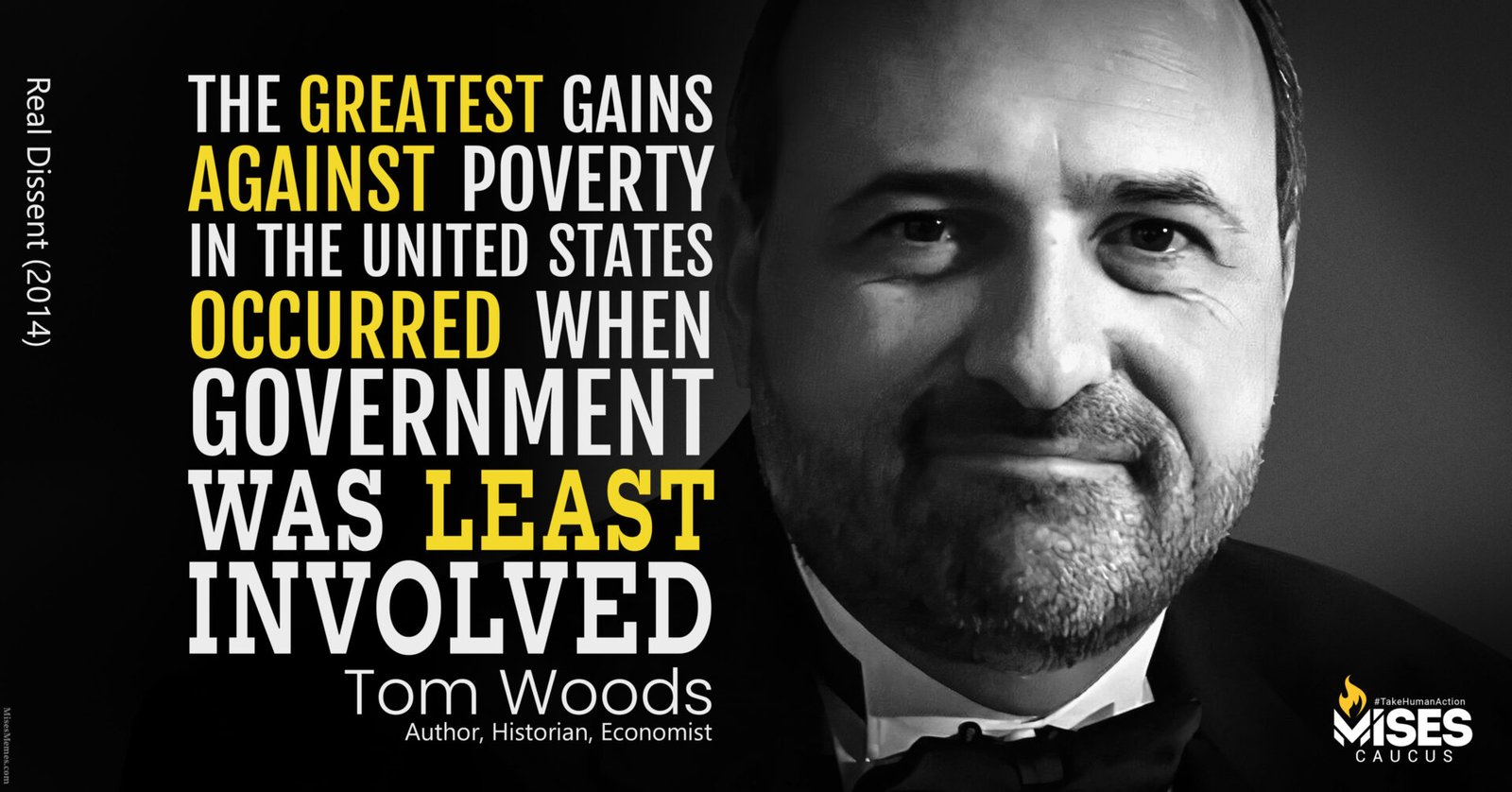
1301: Tom Woods – Greatest Gains Against Poverty

The greatest gains against poverty in the United States occurred when government was least involved. —Tom Woods
Normal Quality (1920×1005 216 KB)
The greatest gains against poverty in the United States occurred when government was least involved. —Tom Woods
Normal Quality (1920×1372 280 KB)
The greatest gains against poverty in the United States occurred when government was least involved. —Tom Woods

The greatest gains against poverty in the United States occurred when government was least involved. —Tom Woods

1248: Murray Rothbard – Statists are Really Opposed to Charity

Statists, in fact, are really opposed to charity. They often argue that charity is demeaning and degrading to the recipient, and that he should therefore be taught that the money is rightly his, to be given to him by the government as his due. An act of charity, when given voluntarily, is generally considered temporary and offered with the object of helping a man to help himself. But when the dole is ladled out by the State, it becomes permanent and perpetually degrading, keeping the recipients in a state of subservience. Anyone who considers private charity degrading must logically conclude that State charity is far more so. —Murray Rothbard
Normal Quality (3840×2010 146 KB)
Statists, in fact, are really opposed to charity. They often argue that charity is demeaning and degrading to the recipient, and that he should therefore be taught that the money is rightly his, to be given to him by the government as his due. An act of charity, when given voluntarily, is generally considered temporary and offered with the object of helping a man to help himself. But when the dole is ladled out by the State, it becomes permanent and perpetually degrading, keeping the recipients in a state of subservience. Anyone who considers private charity degrading must logically conclude that State charity is far more so. —Murray Rothbard
Normal Quality (2900×3840 157 KB)

Statists, in fact, are really opposed to charity. They often argue that charity is demeaning and degrading to the recipient, and that he should therefore be taught that the money is rightly his, to be given to him by the government as his due. An act of charity, when given voluntarily, is generally considered temporary and offered with the object of helping a man to help himself. But when the dole is ladled out by the State, it becomes permanent and perpetually degrading, keeping the recipients in a state of subservience. Anyone who considers private charity degrading must logically conclude that State charity is far more so. —Murray Rothbard

1247: Murray Rothbard – Taking Wealth by Force is Not Charity

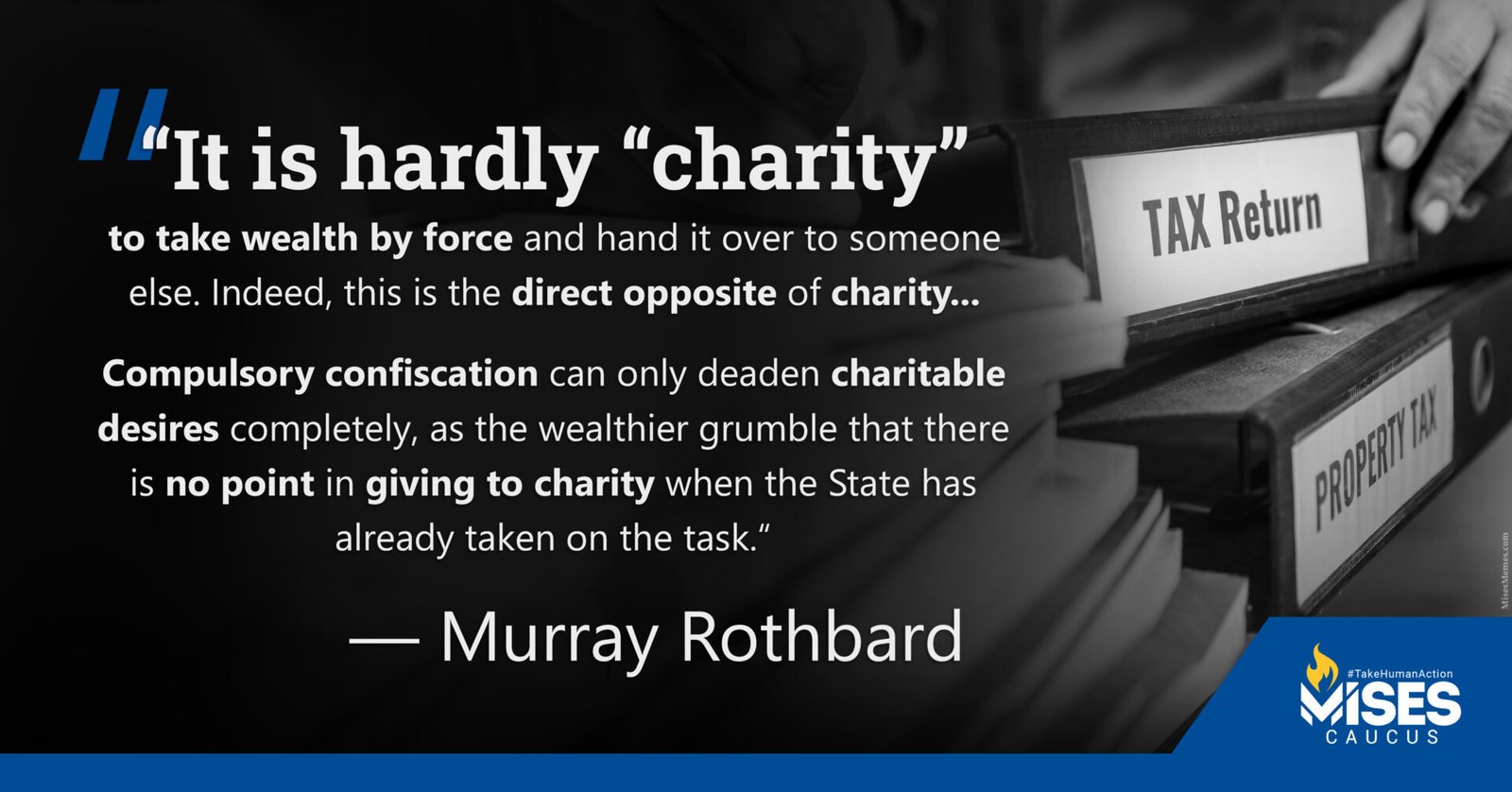
It is hardly “charity” to take wealth by force and hand it over to someone else. Indeed, this is the direct opposite of charity… Compulsory confiscation can only deaden charitable desires completely, as the wealthier grumble that there is no point in giving to charity when the State has already taken on the task. —Murray Rothbard
Normal Quality (1920×1005 170 KB)
It is hardly “charity” to take wealth by force and hand it over to someone else. Indeed, this is the direct opposite of charity… Compulsory confiscation can only deaden charitable desires completely, as the wealthier grumble that there is no point in giving to charity when the State has already taken on the task. —Murray Rothbard
Normal Quality (1920×1372 221 KB)
It is hardly “charity” to take wealth by force and hand it over to someone else. Indeed, this is the direct opposite of charity… Compulsory confiscation can only deaden charitable desires completely, as the wealthier grumble that there is no point in giving to charity when the State has already taken on the task. —Murray Rothbard

It is hardly “charity” to take wealth by force and hand it over to someone else. Indeed, this is the direct opposite of charity… Compulsory confiscation can only deaden charitable desires completely, as the wealthier grumble that there is no point in giving to charity when the State has already taken on the task. —Murray Rothbard

1163: Tom Woods – The Delusion of Keynesians

Keynesians think that you can take water from the deep end of the swimming, pump it into the shallow end of the swimming pool and somehow the water level of the swimming pool will rise. —Tom Woods
Normal Quality (1920×1005 209 KB)
Keynesians think that you can take water from the deep end of the swimming, pump it into the shallow end of the swimming pool and somehow the water level of the swimming pool will rise. —Tom Woods
Normal Quality (1920×1372 290 KB)
Keynesians think that you can take water from the deep end of the swimming, pump it into the shallow end of the swimming pool and somehow the water level of the swimming pool will rise. —Tom Woods

Keynesians think that you can take water from the deep end of the swimming, pump it into the shallow end of the swimming pool and somehow the water level of the swimming pool will rise. —Tom Woods

1160: Friedrich Hayek – Democratic Socialism Produces Something Different

Democratic Socialism, the great utopia of the last few generations, is not only unachievable, but that to strive for it produces something that many will not believe until the connection has been laid bare in all its aspects. —F.A. Hayek
Normal Quality (3840×2010 208 KB)
Democratic Socialism, the great utopia of the last few generations, is not only unachievable, but that to strive for it produces something that many will not believe until the connection has been laid bare in all its aspects. —F.A. Hayek
Normal Quality (1920×1920 522 KB)

Democratic Socialism, the great utopia of the last few generations, is not only unachievable, but that to strive for it produces something that many will not believe until the connection has been laid bare in all its aspects. —F.A. Hayek

1159: Thomas Sowell – Slavery Can Never Be Forgotten Nor Forgiven

To say that one has been compensated is to say that things have been set right. Slavery can neither be forgotten nor forgiven. Certainly NOT by those who never suffered it personally, and certainly NOT in exchange for money or other benefits. —Thomas Sowell (Race & Culture: A World View)
Normal Quality (1920×1005 178 KB)
To say that one has been compensated is to say that things have been set right. Slavery can neither be forgotten nor forgiven. Certainly NOT by those who never suffered it personally, and certainly NOT in exchange for money or other benefits. —Thomas Sowell (Race & Culture: A World View)
Normal Quality (1920×1372 219 KB)

To say that one has been compensated is to say that things have been set right. Slavery can neither be forgotten nor forgiven. Certainly NOT by those who never suffered it personally, and certainly NOT in exchange for money or other benefits. —Thomas Sowell (Race & Culture: A World View)

1156: Frederic Bastiat – The State Lives at the Expense of Everyone

Everyone wants to live at the expense of the State. They forget that the State lives at the expense of everyone. —Frederic Bastiat
Normal Quality (1920×1005 188 KB)
Everyone wants to live at the expense of the State. They forget that the State lives at the expense of everyone. —Frederic Bastiat
Normal Quality (1920×1372 235 KB)
Everyone wants to live at the expense of the State. They forget that the State lives at the expense of everyone. —Frederic Bastiat

Everyone wants to live at the expense of the State. They forget that the State lives at the expense of everyone. —Frederic Bastiat