1375: Murray Rothbard – Man Cannot Live as a Parasite

The man who seizes another's property is living in basic contradiction to his own nature as a man. For man can only live and prosper by his own production and exchange of products. The aggressor, on the other hand, is not a producer at all but a predator; he lives parasitically off the labor and product of others. Parasites must have non-parasites to feed upon. The parasite depends completely on the production of the host body. Any increase in coercive exploitation (parasitism) decreases the quantity and the output of the producers, until finally, if the producers die out, the parasites will quickly follow suit. Thus, parasitism cannot be a universal ethic. —Murray Rothbard
Normal Quality (3840×2010 139 KB)
The man who seizes another's property is living in basic contradiction to his own nature as a man. For man can only live and prosper by his own production and exchange of products. The aggressor, on the other hand, is not a producer at all but a predator; he lives parasitically off the labor and product of others. Parasites must have non-parasites to feed upon. The parasite depends completely on the production of the host body. Any increase in coercive exploitation (parasitism) decreases the quantity and the output of the producers, until finally, if the producers die out, the parasites will quickly follow suit. Thus, parasitism cannot be a universal ethic. —Murray Rothbard

Normal Quality (3073×3840 158 KB)
The man who seizes another's property is living in basic contradiction to his own nature as a man. For man can only live and prosper by his own production and exchange of products. The aggressor, on the other hand, is not a producer at all but a predator; he lives parasitically off the labor and product of others. Parasites must have non-parasites to feed upon. The parasite depends completely on the production of the host body. Any increase in coercive exploitation (parasitism) decreases the quantity and the output of the producers, until finally, if the producers die out, the parasites will quickly follow suit. Thus, parasitism cannot be a universal ethic. —Murray Rothbard

The man who seizes another’s property is living in basic contradiction to his own nature as a man. For man can only live and prosper by his own production and exchange of products. The aggressor, on the other hand, is not a producer at all but a predator; he lives parasitically off the labor and product of others. Parasites must have non-parasites to feed upon. The parasite depends completely on the production of the host body. Any increase in coercive exploitation (parasitism) decreases the quantity and the output of the producers, until finally, if the producers die out, the parasites will quickly follow suit. Thus, parasitism cannot be a universal ethic. —Murray Rothbard

1322: Gloria Alvarez – You Cannot Admire Dictators

If you are up for life, if you defend life, you cannot admire murderers. If you are up for defending private property, you cannot admire thieves. If you are up for liberty you cannot admire dictators. —Gloria Alvarez
Normal Quality (3072×3840 159 KB)

If you are up for life, if you defend life, you cannot admire murderers. If you are up for defending private property, you cannot admire thieves. If you are up for liberty you cannot admire dictators. —Gloria Alvarez

1299: Walter Williams – Commitment to Liberty

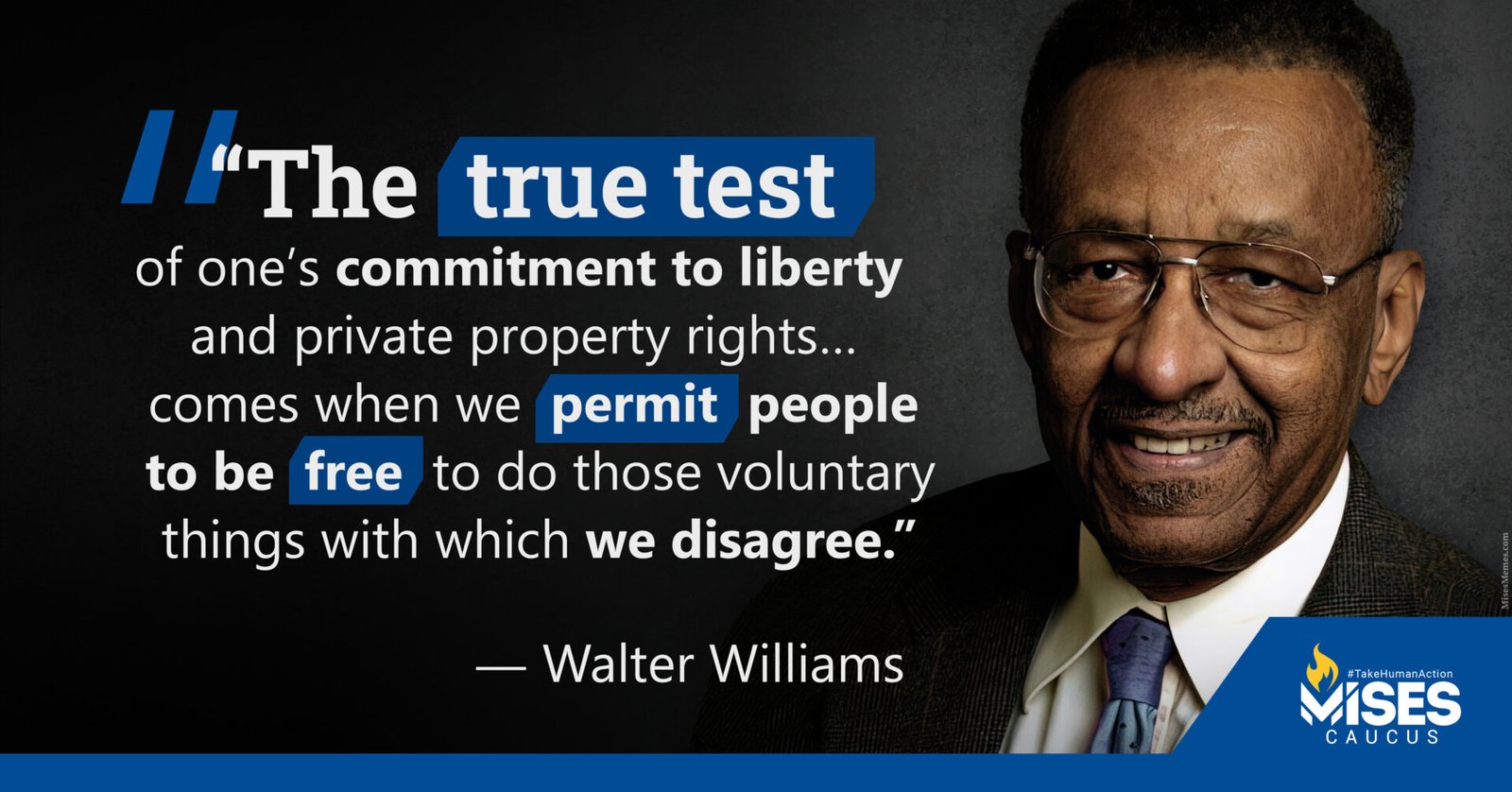
The true test of one’s commitment to liberty and private property rights… comes when we permit people to be free to do those voluntary things with which we disagree. —Walter Williams
Normal Quality (1920×1005 240 KB)
The true test of one’s commitment to liberty and private property rights… comes when we permit people to be free to do those voluntary things with which we disagree. —Walter Williams
Normal Quality (1920×1372 339 KB)
The true test of one’s commitment to liberty and private property rights… comes when we permit people to be free to do those voluntary things with which we disagree. —Walter Williams

The true test of one’s commitment to liberty and private property rights… comes when we permit people to be free to do those voluntary things with which we disagree. —Walter Williams

1280: Henry Hazlitt: The Gospel of Marxism

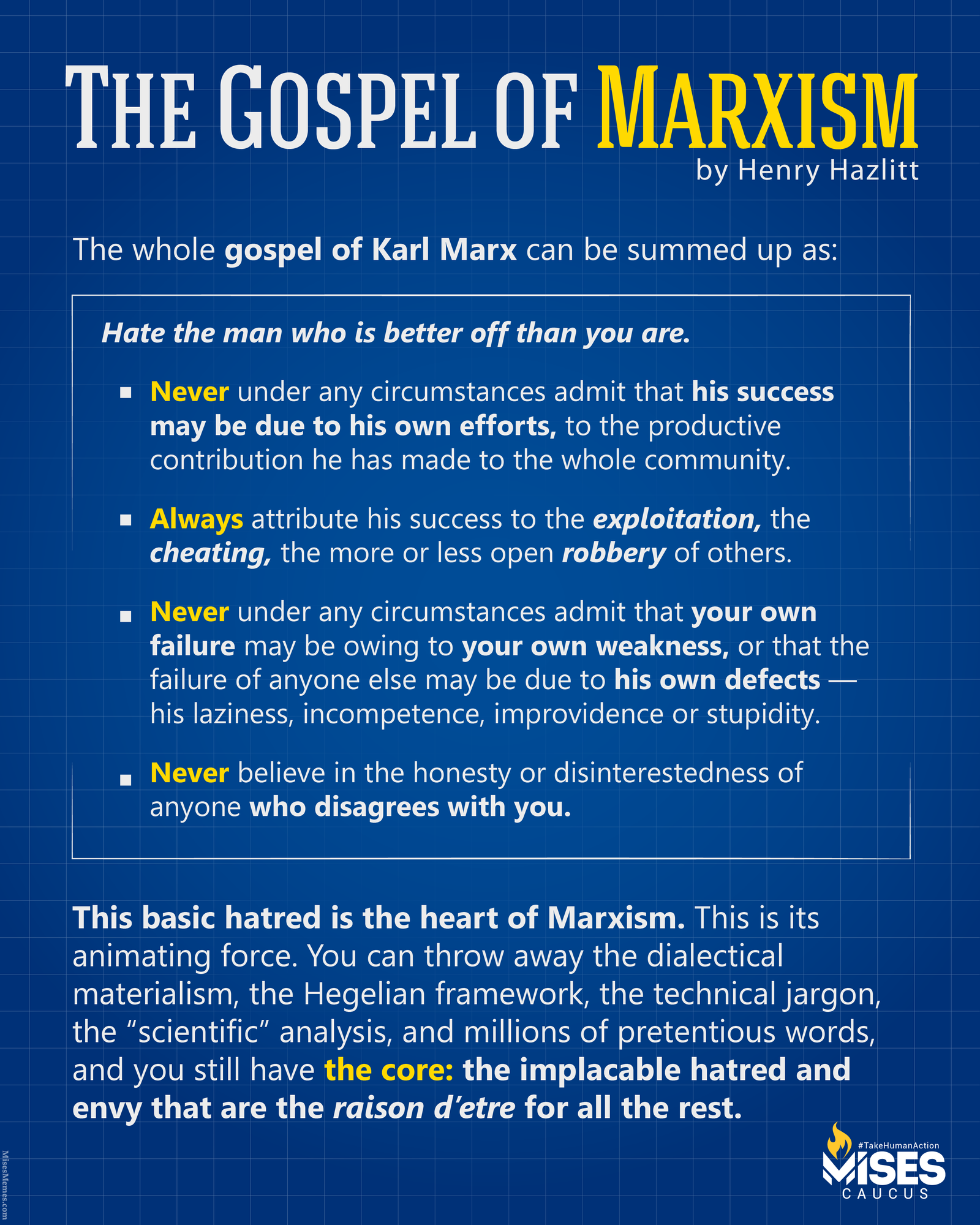
The whole gospel of Karl Marx can be summed up in a single sentence: Hate the man who is better off than you are. Never under any circumstances admit that his success may be due to his own efforts, to the productive contribution he has made to the whole community. Always attribute his success to the exploitation, the cheating, the more or less open robbery of others.

Never under any circumstances admit that your own failure may be owing to your own weakness, or that the failure of anyone else may be due to his own defects — his laziness, incompetence, improvidence or stupidity. Never believe in the honesty or disinterestedness of anyone who disagrees with you.

This basic hatred is the heart of Marxism. This is its animating force. You can throw away the dialectical materialism, the Hegelian framework, the technical jargon, the “scientific” analysis, and millions of pretentious words, and you still have the core: the implacable hatred and envy that are the raison d’etre for all the rest.

— Henry Hazlitt
Normal Quality (3072×3840 844 KB)
The whole gospel of Karl Marx can be summed up in a single sentence: Hate the man who is better off than you are. Never under any circumstances admit that his success may be due to his own efforts, to the productive contribution he has made to the whole community. Always attribute his success to the exploitation, the cheating, the more or less open robbery of others. Never under any circumstances admit that your own failure may be owing to your own weakness, or that the failure of anyone else may be due to his own defects — his laziness, incompetence, improvidence or stupidity. Never believe in the honesty or disinterestedness of anyone who disagrees with you. This basic hatred is the heart of Marxism. This is its animating force. You can throw away the dialectical materialism, the Hegelian framework, the technical jargon, the “scientific” analysis, and millions of pretentious words, and you still have the core: the implacable hatred and envy that are the raison d’etre for all the rest. — Henry Hazlitt
Normal Quality (3072×3840 863 KB)

The whole gospel of Karl Marx can be summed up in a single sentence: Hate the man who is better off than you are. Never under any circumstances admit that his success may be due to his own efforts, to the productive contribution he has made to the whole community. Always attribute his success to the exploitation, the cheating, the more or less open robbery of others.

Never under any circumstances admit that your own failure may be owing to your own weakness, or that the failure of anyone else may be due to his own defects — his laziness, incompetence, improvidence or stupidity. Never believe in the honesty or disinterestedness of anyone who disagrees with you.

This basic hatred is the heart of Marxism. This is its animating force. You can throw away the dialectical materialism, the Hegelian framework, the technical jargon, the “scientific” analysis, and millions of pretentious words, and you still have the core: the implacable hatred and envy that are the raison d’etre for all the rest.

— Henry Hazlitt

1251: Murray Rothbard – Taxation is Theft

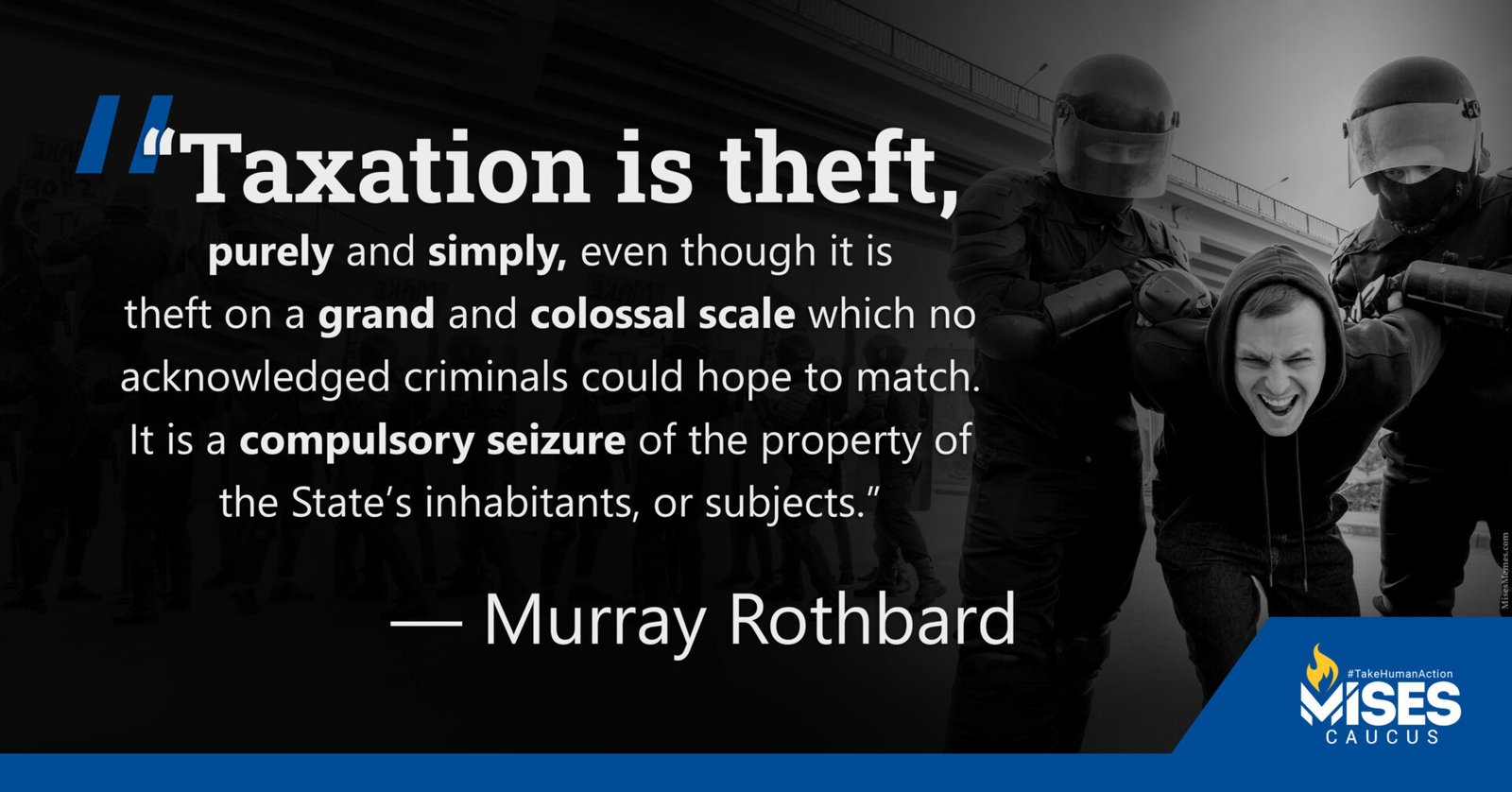
Taxation is theft, purely and simply, even though it is theft on a grand and colossal scale which no acknowledged criminals could hope to match. It is a compulsory seizure of the property of the State’s inhabitants, or subjects.— Murray Rothbard
Normal Quality (1920×1005 181 KB)
Taxation is theft, purely and simply, even though it is theft on a grand and colossal scale which no acknowledged criminals could hope to match. It is a compulsory seizure of the property of the State’s inhabitants, or subjects.— Murray Rothbard
Normal Quality (1920×1372 233 KB)
Taxation is theft, purely and simply, even though it is theft on a grand and colossal scale which no acknowledged criminals could hope to match. It is a compulsory seizure of the property of the State’s inhabitants, or subjects.— Murray Rothbard

Taxation is theft, purely and simply, even though it is theft on a grand and colossal scale which no acknowledged criminals could hope to match. It is a compulsory seizure of the property of the State’s inhabitants, or subjects.— Murray Rothbard

1244: Murray Rothbard – The State is an Illegitimate Institution

The State is an inherently illegitimate institution of organized aggression against the persons and properties of its subject. Rather than necessary to society… it lives parasitically off of the productive activities of private citizens. —Murray Rothbard
Normal Quality (1920×1005 292 KB)
The State is an inherently illegitimate institution of organized aggression against the persons and properties of its subject. Rather than necessary to society… it lives parasitically off of the productive activities of private citizens. —Murray Rothbard

Normal Quality (1920×1372 417 KB)
The State is an inherently illegitimate institution of organized aggression against the persons and properties of its subject. Rather than necessary to society… it lives parasitically off of the productive activities of private citizens. —Murray Rothbard

The State is an inherently illegitimate institution of organized aggression against the persons and properties of its subject. Rather than necessary to society… it lives parasitically off of the productive activities of private citizens. —Murray Rothbard

1242: Larry Sharpe – Hemp Should Be Regulated Like Onions

Hemp and marijuana should be regulated like onions. If you can grow onion in your backyard, you can grow hemp or weed in your backyard. —Larry Sharpe
Normal Quality (1920×1005 234 KB)
Hemp and marijuana should be regulated like onions. If you can grow onion in your backyard, you can grow hemp or weed in your backyard. —Larry Sharpe
Normal Quality (1920×1372 325 KB)
Hemp and marijuana should be regulated like onions. If you can grow onion in your backyard, you can grow hemp or weed in your backyard. —Larry Sharpe

Hemp and marijuana should be regulated like onions. If you can grow onion in your backyard, you can grow hemp or weed in your backyard. —Larry Sharpe

1118: Antony Davies – Civil Asset Forfeiture & Criminals

More Americans lose their property to police in the form of Civil Asset Forfeiture than they do to criminals. — Antony Davies (Cooperation & Coercion)

Normal Quality (1920×1005 211 KB)
More Americans lose their property to police in the form of Civil Asset Forfeiture than they do to criminals. — Antony Davies (Cooperation & Coercion)

Normal Quality (1920×1372 287 KB)
More Americans lose their property to police in the form of Civil Asset Forfeiture than they do to criminals. — Antony Davies (Cooperation & Coercion)

More Americans lose their property to police in the form of Civil Asset Forfeiture than they do to criminals. — Antony Davies (Cooperation & Coercion)

More Americans lose their property to police in the form of Civil Asset Forfeiture than they do to criminals. — Antony Davies (Cooperation & Coercion)

1087: Murray Rothbard – How Do We Define Rights?

"Right" has cogently and trenchantly been defined by Professor Sadowsky:

“When we say that one has the right to do certain things we mean this and only this, that it would be immoral for another, alone or in combination, to stop him from doing this by the use of physical force or the threat thereof. We do not mean that any use a man makes of his property within the limits set forth is necessarily a moral use.”

Sadowsky's definition highlights the crucial distinction between a man's right and the morality or immorality of his exercise of that right. —Murray Rothbard (The Ethics of Liberty)

Normal Quality (2948×3840 264 KB)
“Right” has cogently and trenchantly been defined by Professor Sadowsky: “When we say that one has the right to do certain things we mean this and only this, that it would be immoral for another, alone or in combination, to stop him from doing this by the use of physical force or the threat thereof. We do not mean that any use a man makes of his property within the limits set forth is necessarily a moral use.” Sadowsky’s definition highlights the crucial distinction between a man’s right and the morality or immorality of his exercise of that right. —Murray Rothbard (The Ethics of Liberty)