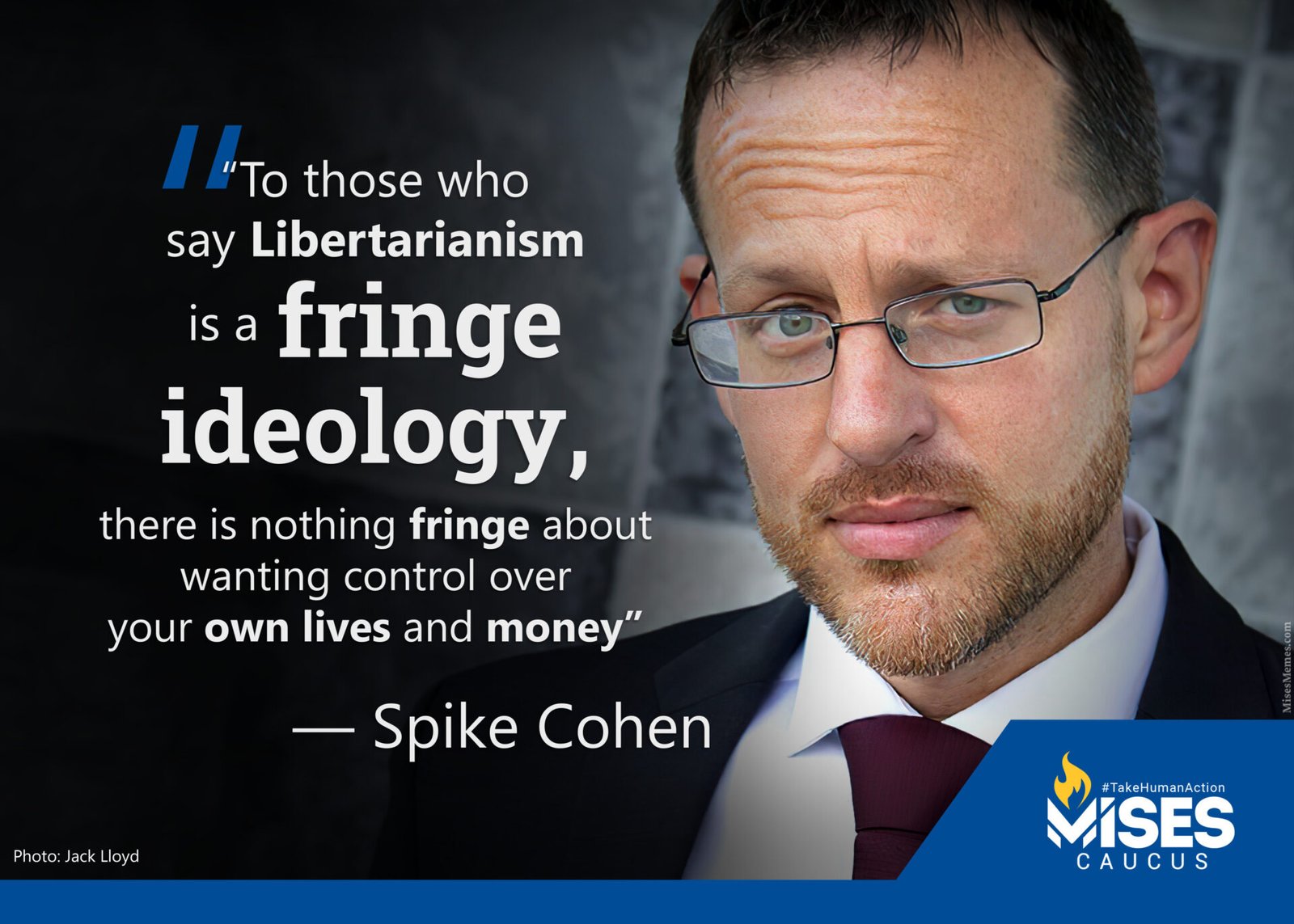
We're not just a third party, we're a completely different way of looking at how government interacts with the people. We believe that people do best when they are the most free. —Spike Cohen
We’re not just a third party, we’re a completely different way of looking at how government interacts with the people. We believe that people do best when they are the most free. —Spike Cohen
The answer isn’t to run away from conflict or challenges — it’s to address it directly, conquer our challenges in messaging and internal conflict, and integrate our shadow. —Angela McArdle
The answer isn’t to run away from conflict or challenges — it’s to address it directly, conquer our challenges in messaging and internal conflict, and integrate our shadow. —Angela McArdle
We have unfortunately created a little class of mini bureaucrats who are more concerned with keeping their jobs and perpetuating the institution as an institution and raising money than they are with spreading the message. When we started out our goal was to spread the word, it was sort of evangelical, to spread the word of liberty out to the world at large and we had people like Murray Rothbard and John Hospers and many other distinguished thinkers of that era involved in the party. Now we’re down to the level of people who are I think for the most part well intended, but when compared to those men are several orders down the intellectual scale and they are absorbed with minutia they are concerned with budgets, they are afraid to say anything that might scare people, that might keep people from voting for us. So it’s become a very timid organization in the past 6 or 8 years. —David Nolan
We have unfortunately created a little class of mini bureaucrats who are more concerned with keeping their jobs and perpetuating the institution as an institution and raising money than they are with spreading the message. When we started out our goal was to spread the word, it was sort of evangelical, to spread the word of liberty out to the world at large and we had people like Murray Rothbard and John Hospers and many other distinguished thinkers of that era involved in the party. Now we’re down to the level of people who are I think for the most part well intended, but when compared to those men are several orders down the intellectual scale and they are absorbed with minutia they are concerned with budgets, they are afraid to say anything that might scare people, that might keep people from voting for us. So it’s become a very timid organization in the past 6 or 8 years. —David Nolan
What is the major news media afraid of? Could it be that most Americans share the Libertarian ideals of Republican fiscal conservatism and Democratic social liberalism? Perhaps such Libertarian views represent a genuine threat to both major parties. —Tonie Theodora Nathan
What is the major news media afraid of? Could it be that most Americans share the Libertarian ideals of Republican fiscal conservatism and Democratic social liberalism? Perhaps such Libertarian views represent a genuine threat to both major parties. —Tonie Theodora Nathan
It is rare to find a utilitarian who is also radical, who burns for immediate abolition of evil and coercion. Utilitarians, with their devotion to expediency, almost inevitably oppose any sort of upsetting or radical change. Hence, utilitarians are never immediate abolitionists. They became mere gradualist reformers.
But in becoming reformers, they also put themselves inevitably into the position of advisers and efficiency experts to the State. In other words, they inevitably came to abandon libertarian principle as well as a principled libertarian strategy. The utilitarians wound up as apologists for the existing order, for the status quo. Thus, they wound up as the image of the thing they had fought. —Murray Rothbard (For a New Liberty)
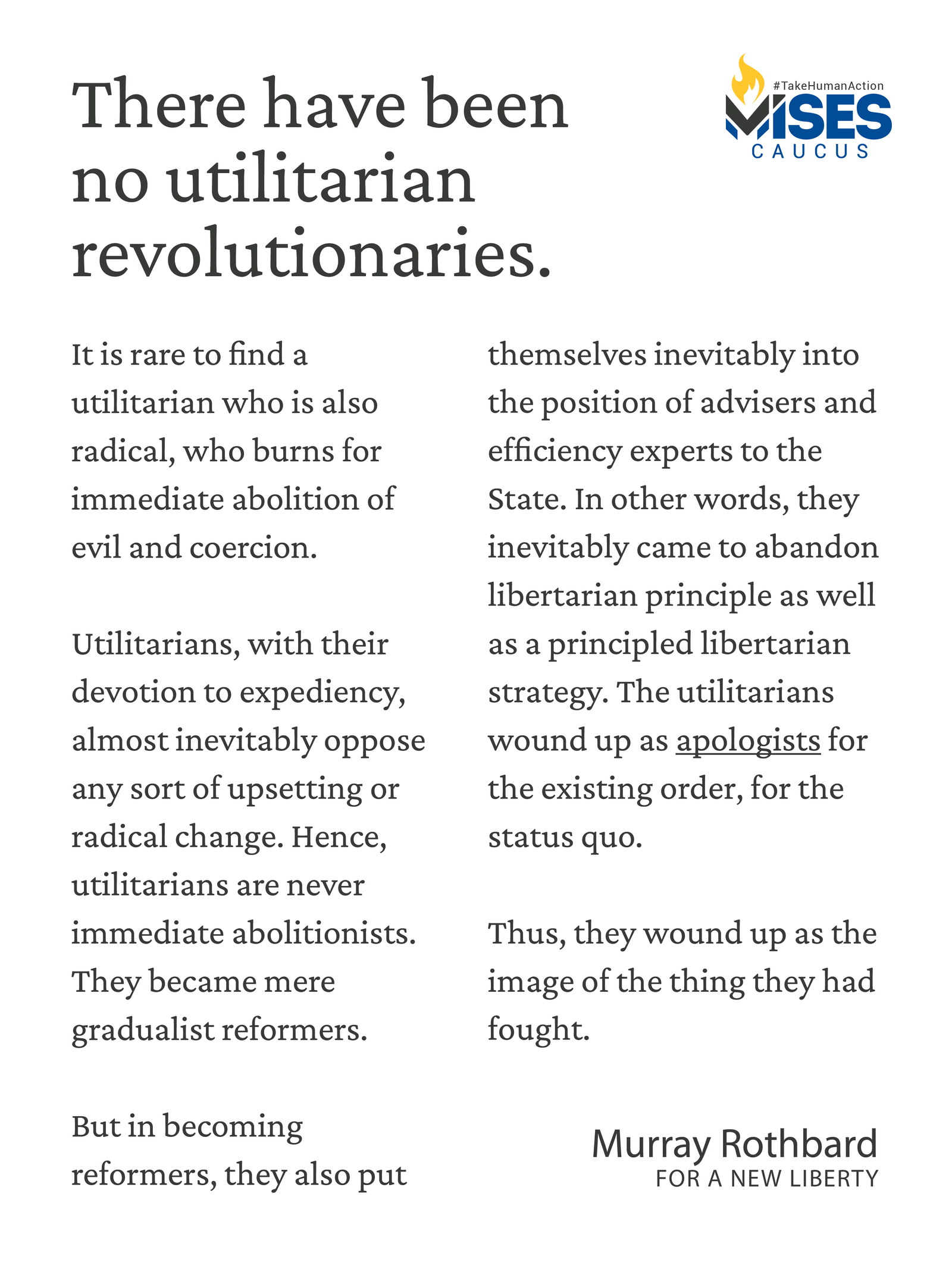
It is rare to find a utilitarian who is also radical, who burns for immediate abolition of evil and coercion. Utilitarians, with their devotion to expediency, almost inevitably oppose any sort of upsetting or radical change. Hence, utilitarians are never immediate abolitionists. They became mere gradualist reformers. But in becoming reformers, they also put themselves inevitably into the position of advisers and efficiency experts to the State. In other words, they inevitably came to abandon libertarian principle as well as a principled libertarian strategy. The utilitarians wound up as apologists for the existing order, for the status quo. Thus, they wound up as the image of the thing they had fought. —Murray Rothbard (For a New Liberty)