1405: Karl Hess – Integration & Segregation

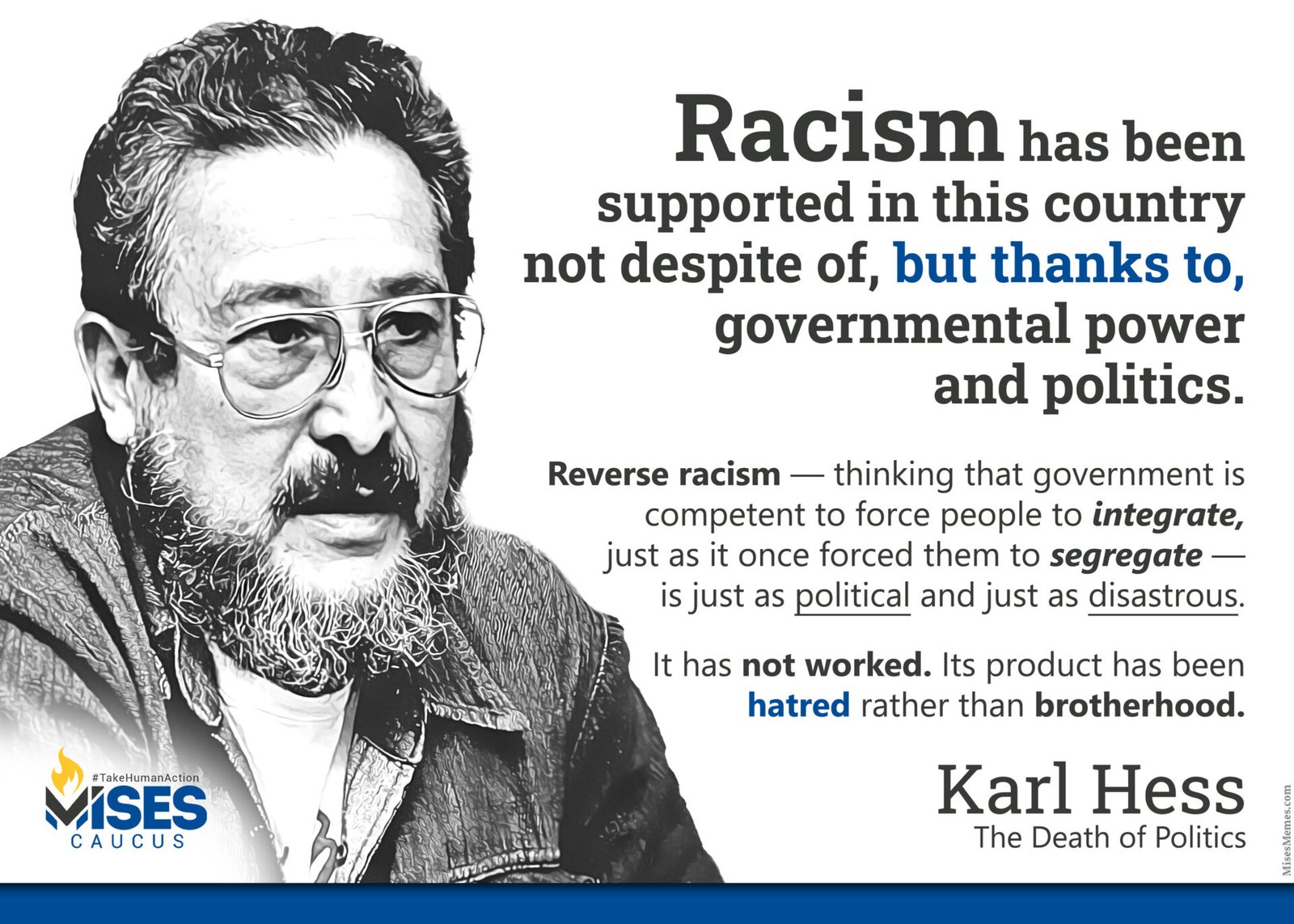
Racism has been supported in this country not despite of, but thanks to, governmental power and politics. Reverse racism — thinking that government is competent to force people to integrate, just as it once forced them to segregate — is just as political and just as disastrous. It has not worked. Its product has been hatred rather than brotherhood. —Karl Hess
Normal Quality (1920×1005 248 KB)
Racism has been supported in this country not despite of, but thanks to, governmental power and politics. Reverse racism — thinking that government is competent to force people to integrate, just as it once forced them to segregate — is just as political and just as disastrous. It has not worked. Its product has been hatred rather than brotherhood. —Karl Hess
Normal Quality (1920×1372 340 KB)
Racism has been supported in this country not despite of, but thanks to, governmental power and politics. Reverse racism — thinking that government is competent to force people to integrate, just as it once forced them to segregate — is just as political and just as disastrous. It has not worked. Its product has been hatred rather than brotherhood. —Karl Hess

Racism has been supported in this country not despite of, but thanks to, governmental power and politics. Reverse racism — thinking that government is competent to force people to integrate, just as it once forced them to segregate — is just as political and just as disastrous. It has not worked. Its product has been hatred rather than brotherhood. —Karl Hess

1404: Ayn Rand – Statism is Perpetual Violence

Statism is a system of institutionalized violence and perpetual civil war. It leaves men no choice but to fight to seize political power—to rob or be robbed, to kill or be killed. When brute force is the only criterion of social conduct, and unresisting surrender to destruction is the only alternative, even the lowest of men, even an animal—even a cornered rat—will fight. There can be no peace within an enslaved nation. —Ayn Rand
Normal Quality (1920×1005 240 KB)
Statism is a system of institutionalized violence and perpetual civil war. It leaves men no choice but to fight to seize political power—to rob or be robbed, to kill or be killed. When brute force is the only criterion of social conduct, and unresisting surrender to destruction is the only alternative, even the lowest of men, even an animal—even a cornered rat—will fight. There can be no peace within an enslaved nation. —Ayn Rand
Normal Quality (1920×1372 315 KB)
Statism is a system of institutionalized violence and perpetual civil war. It leaves men no choice but to fight to seize political power—to rob or be robbed, to kill or be killed. When brute force is the only criterion of social conduct, and unresisting surrender to destruction is the only alternative, even the lowest of men, even an animal—even a cornered rat—will fight. There can be no peace within an enslaved nation. —Ayn Rand

Statism is a system of institutionalized violence and perpetual civil war. It leaves men no choice but to fight to seize political power—to rob or be robbed, to kill or be killed. When brute force is the only criterion of social conduct, and unresisting surrender to destruction is the only alternative, even the lowest of men, even an animal—even a cornered rat—will fight. There can be no peace within an enslaved nation. —Ayn Rand

1385: Gloria Alvarez – Government Power

The more power you give the government the less power you have to control your life. —Gloria Alvarez
Normal Quality (1920×1005 305 KB)
The more power you give the government the less power you have to control your life. —Gloria Alvarez
Normal Quality (1920×1372 381 KB)
The more power you give the government the less power you have to control your life. —Gloria Alvarez

The more power you give the government the less power you have to control your life. —Gloria Alvarez

1378: Thomas Sowell – Government Planning

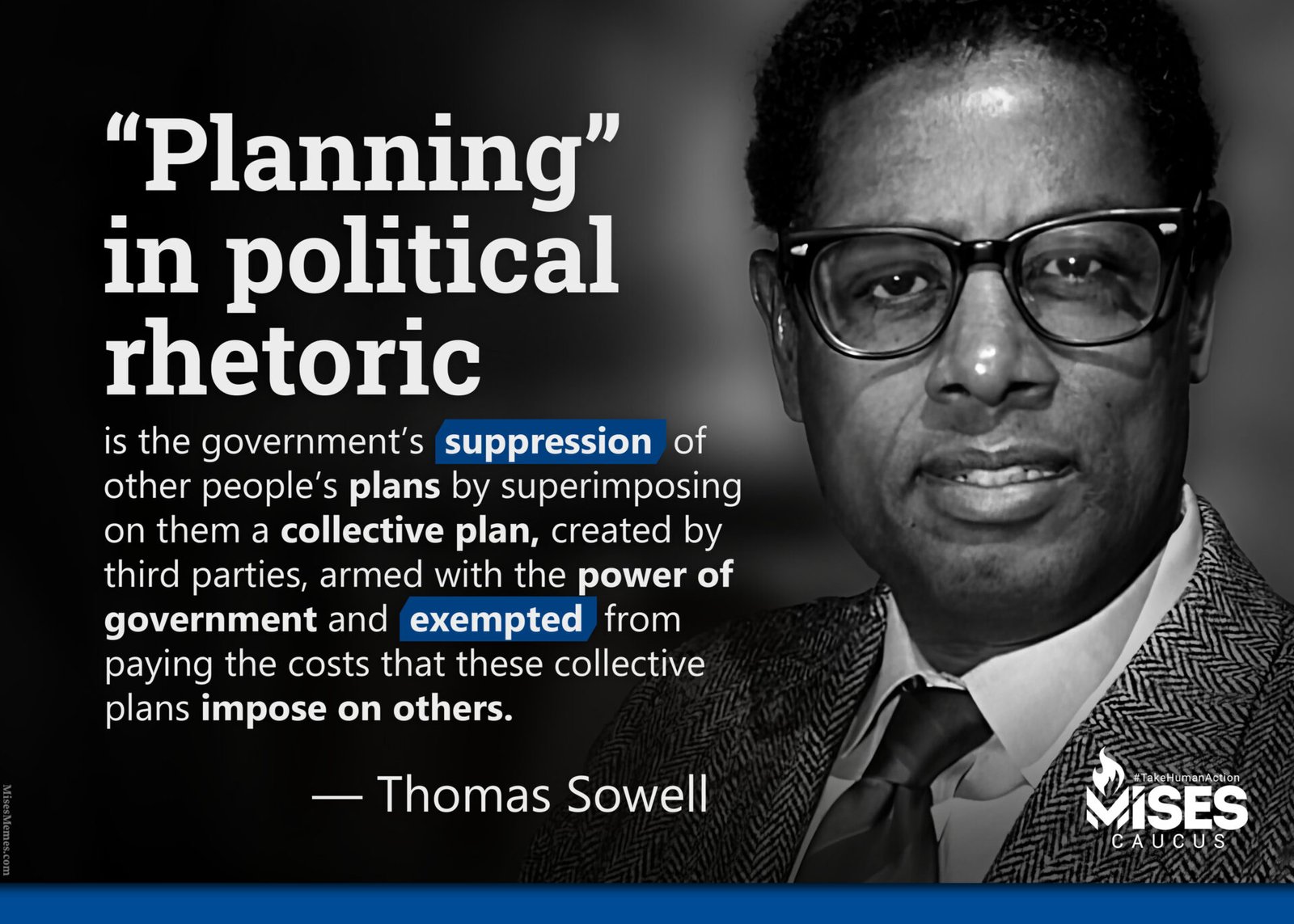
“Planning” in political rhetoric is the government’s suppression of other people’s plans by superimposing on them a collective plan, created by third parties, armed with the power of government and exempted from paying the costs that these collective plans impose on others. —Thomas Sowell
Normal Quality (1920×1005 210 KB)
“Planning” in political rhetoric is the government’s suppression of other people’s plans by superimposing on them a collective plan, created by third parties, armed with the power of government and exempted from paying the costs that these collective plans impose on others. —Thomas Sowell
Normal Quality (1920×1372 272 KB)
“Planning” in political rhetoric is the government’s suppression of other people’s plans by superimposing on them a collective plan, created by third parties, armed with the power of government and exempted from paying the costs that these collective plans impose on others. —Thomas Sowell

“Planning” in political rhetoric is the government’s suppression of other people’s plans by superimposing on them a collective plan, created by third parties, armed with the power of government and exempted from paying the costs that these collective plans impose on others. —Thomas Sowell

1372: Antony Davies – The Humans Who Work in Government

The faith that people unthinkingly place in government to accomplish goals is at the same time faith in the people who work in government. But people who work in government are no more knowledgeable, capable, motivated, or well-intentioned than their counterparts outside of government. Humans who work in government are the very same kinds of humans as those who don’t, and they are subject to all the same motivations like everyone else. So many people miss this fundamental point in so many ways that it is mind-boggling. —Antony Davies
Normal Quality (3840×2010 124 KB)
The faith that people unthinkingly place in government to accomplish goals is at the same time faith in the people who work in government. But people who work in government are no more knowledgeable, capable, motivated, or well-intentioned than their counterparts outside of government. Humans who work in government are the very same kinds of humans as those who don’t, and they are subject to all the same motivations like everyone else. So many people miss this fundamental point in so many ways that it is mind-boggling. —Antony Davies
Normal Quality (3000×3840 141 KB)

The faith that people unthinkingly place in government to accomplish goals is at the same time faith in the people who work in government. But people who work in government are no more knowledgeable, capable, motivated, or well-intentioned than their counterparts outside of government. Humans who work in government are the very same kinds of humans as those who don’t, and they are subject to all the same motivations like everyone else. So many people miss this fundamental point in so many ways that it is mind-boggling. —Antony Davies

1356: Frank Dikotter – The Great Leap Forward

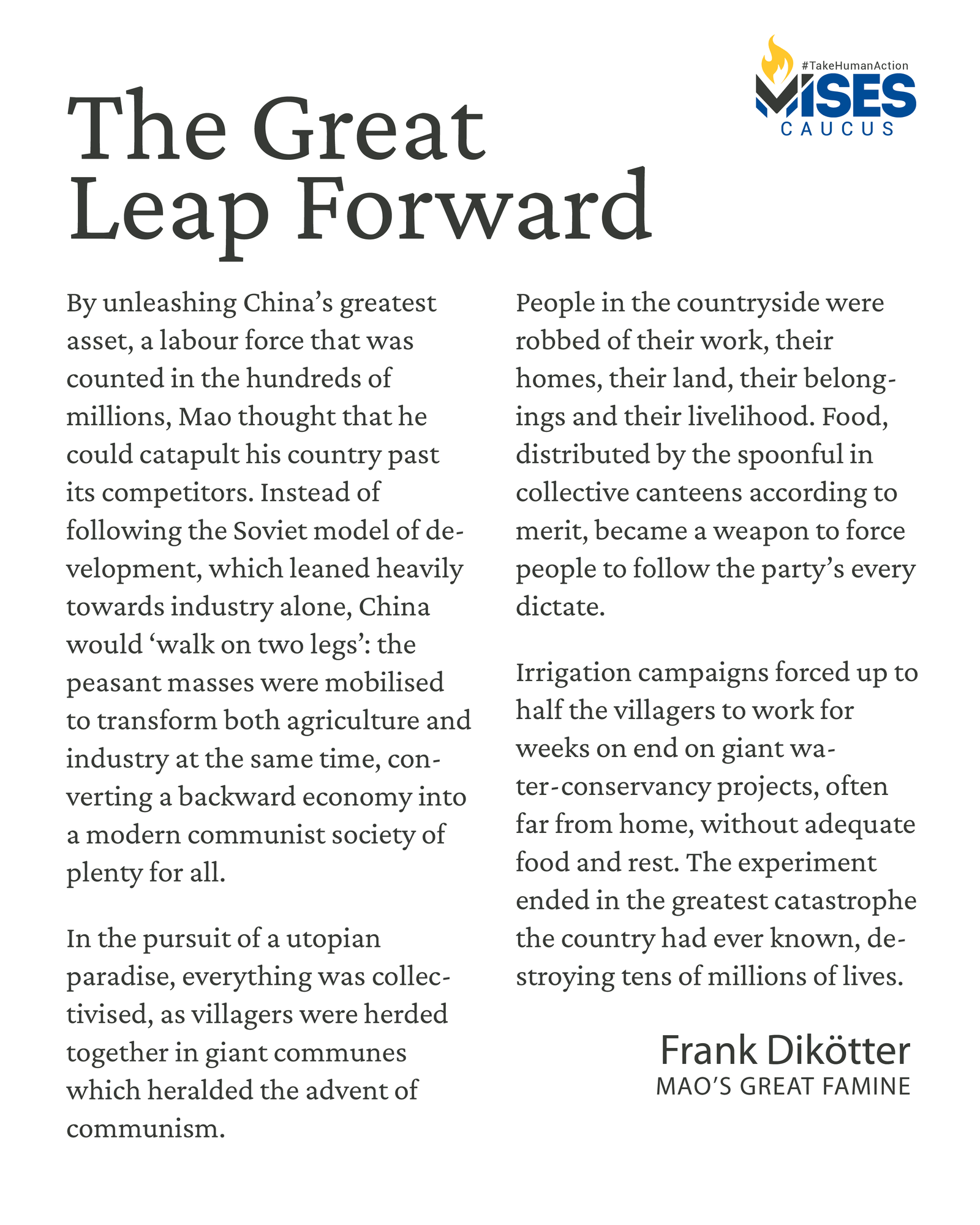
By unleashing China’s greatest asset, a labour force that was counted in the hundreds of millions, Mao thought that he could catapult his country past its competitors. Instead of following the Soviet model of development, which leaned heavily towards industry alone, China would ‘walk on two legs’: the peasant masses were mobilised to transform both agriculture and industry at the same time, converting a backward economy into a modern communist society of plenty for all.
Normal Quality (3072×3840 223 KB)

By unleashing China’s greatest asset, a labour force that was counted in the hundreds of millions, Mao thought that he could catapult his country past its competitors. Instead of following the Soviet model of development, which leaned heavily towards industry alone, China would ‘walk on two legs’: the peasant masses were mobilised to transform both agriculture and industry at the same time, converting a backward economy into a modern communist society of plenty for all.

In the pursuit of a utopian paradise, everything was collectivised, as villagers were herded together in giant communes which heralded the advent of communism.

People in the countryside were robbed of their work, their homes, their land, their belongings and their livelihood. Food, distributed by the spoonful in collective canteens according to merit, became a weapon to force people to follow the party’s every dictate.

Irrigation campaigns forced up to half the villagers to work for weeks on end on giant water-conservancy projects, often far from home, without adequate food and rest. The experiment ended in the greatest catastrophe the country had ever known, destroying tens of millions of lives.

—Frank Dikötter, Mao’s Great Famine

1352: Mary Ruwart – A Parent’s Choice vs the FDA

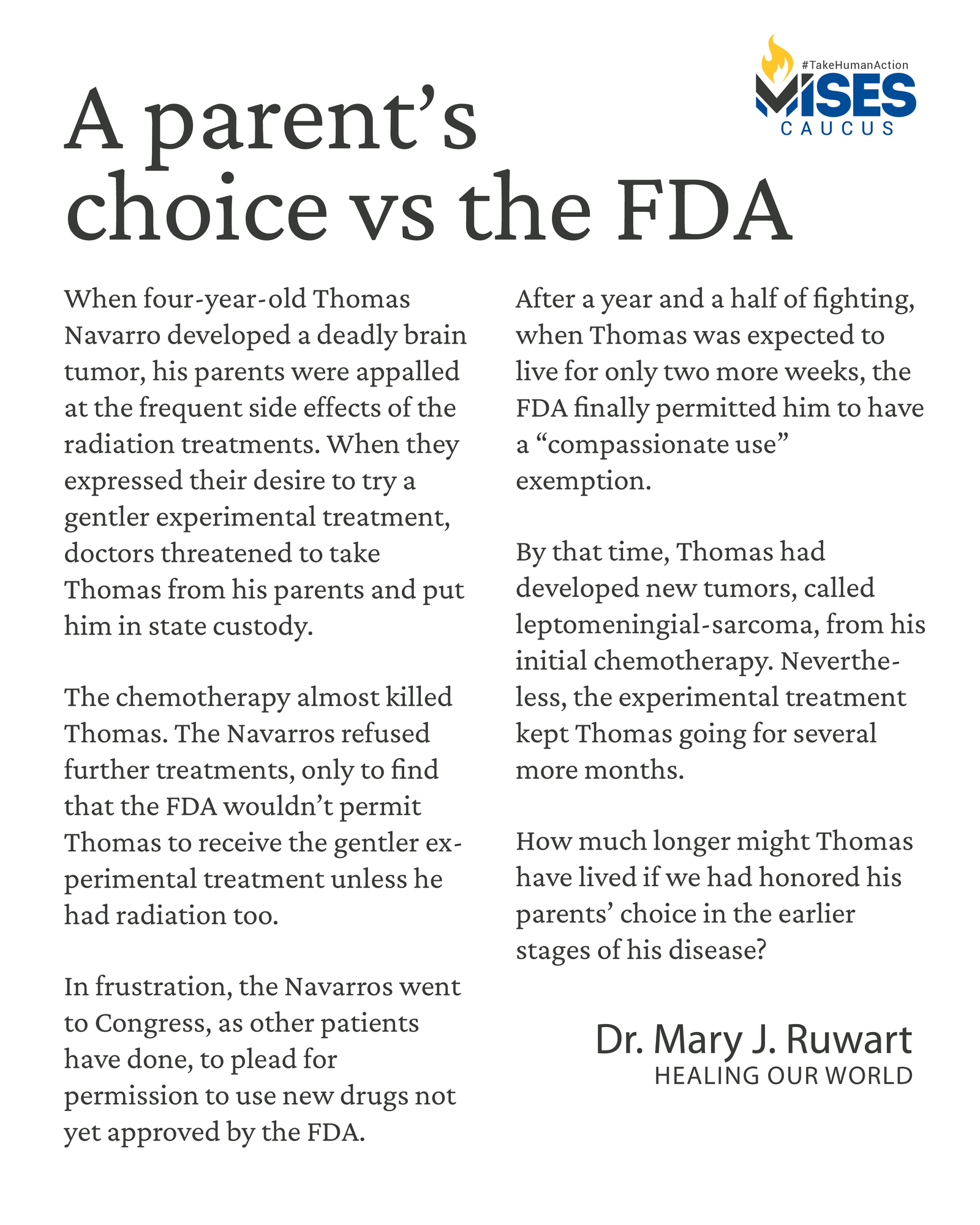
When four-year-old Thomas Navarro developed a deadly brain tumor, his parents were appalled at the frequent side effects of the radiation treatments. When they expressed their desire to try a gentler experimental treatment, doctors threatened to take Thomas from his parents and put him in state custody.

Normal Quality (3072×3840 215 KB)
When four-year-old Thomas Navarro developed a deadly brain tumor, his parents were appalled at the frequent side effects of the radiation treatments. When they expressed their desire to try a gentler experimental treatment, doctors threatened to take Thomas from his parents and put him in state custody.

The chemotherapy almost killed Thomas. The Navarros refused further treatments, only to find that the FDA wouldn’t permit Thomas to receive the gentler experimental treatment unless he had radiation too. In frustration, the Navarros went to Congress, as other patients have done, to plead for permission to use new drugs not yet approved by the FDA. After a year and a half of fighting, when Thomas was expected to live for only two more weeks, the FDA finally permitted him to have a “compassionate use” exemption.

By that time, Thomas had developed new tumors, called leptomeningial-sarcoma, from his initial chemotherapy. Nevertheless, the experimental treatment kept Thomas going for several more months. How much longer might Thomas have lived if we had honored his parents’ choice in the earlier stages of his disease?

—Dr. Mary J. Ruwart, Healing Our World

1351: Aleksandr Solzhenitsyn – When Should One Resist?

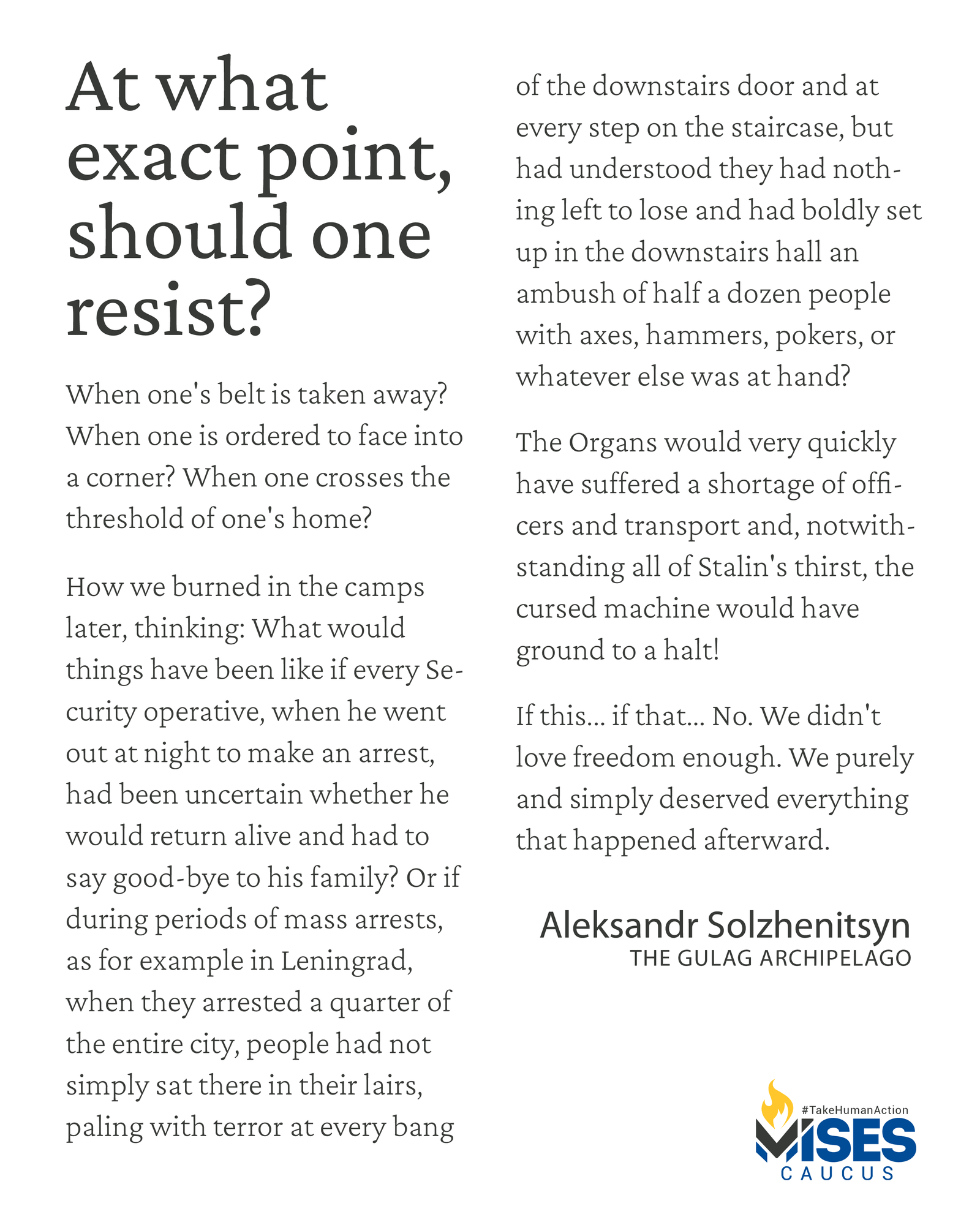
At what exact point, should one resist? When one's belt is taken away? When one is ordered to face into a corner? When one crosses the threshold of one's home?
Normal Quality (3072×3840 243 KB)

At what exact point, should one resist? When one’s belt is taken away? When one is ordered to face into a corner? When one crosses the threshold of one’s home?

How we burned in the camps later, thinking: What would things have been like if every Security operative, when he went out at night to make an arrest, had been uncertain whether he would return alive and had to say good-bye to his family? Or if during periods of mass arrests, as for example in Leningrad, when they arrested a quarter of the entire city, people had not simply sat there in their lairs, paling with terror at every bang of the downstairs door and at every step on the staircase, but had understood they had nothing left to lose and had boldly set up in the downstairs hall an ambush of half a dozen people with axes, hammers, pokers, or whatever else was at hand?

The Organs would very quickly have suffered a shortage of officers and transport and, notwithstanding all of Stalin’s thirst, the cursed machine would have ground to a halt!

If … if … We didn’t love freedom enough. We purely and simply deserved everything that happened afterward.

—Aleksandr Solzhenitsyn, The Gulag Archipelago

1347: Mary Ruwart – Fear of FDA Reprisal

Nobody in the drug industry is going to say anything because if they do the FDA could punish them by dragging their feet on their approvals, which could destroy a company, and it has destroyed many. So no one is going to speak out. —Dr. Mary J. Ruwart
Normal Quality (1920×1005 166 KB)
Nobody in the drug industry is going to say anything because if they do the FDA could punish them by dragging their feet on their approvals, which could destroy a company, and it has destroyed many. So no one is going to speak out. —Dr. Mary J. Ruwart
Normal Quality (1920×1372 222 KB)
Nobody in the drug industry is going to say anything because if they do the FDA could punish them by dragging their feet on their approvals, which could destroy a company, and it has destroyed many. So no one is going to speak out. —Dr. Mary J. Ruwart

Nobody in the drug industry is going to say anything because if they do the FDA could punish them by dragging their feet on their approvals, which could destroy a company, and it has destroyed many. So no one is going to speak out. —Dr. Mary J. Ruwart

1339: Thomas DiLorenzo – Working Just to Pay Taxes

Governments confiscate more than a third of all family income. Each year the average American taxpayer works 127 days, from January 1st until May 7th — just to pay taxes. —Thomas DiLorenzo
Download Print Quality (3840×2010 445 KB)  |  Normal Quality (1920×1005 152 KB)
Governments confiscate more than a third of all family income. Each year the average American taxpayer works 127 days, from January 1st until May 7th — just to pay taxes. —Thomas DiLorenzo
Normal Quality (1536×1920 291 KB)
Governments confiscate more than a third of all family income. Each year the average American taxpayer works 127 days, from January 1st until May 7th — just to pay taxes. —Thomas DiLorenzo

Governments confiscate more than a third of all family income. Each year the average American taxpayer works 127 days, from January 1st until May 7th — just to pay taxes. —Thomas DiLorenzo