1289: Ludwig von Mises – Deification of Government

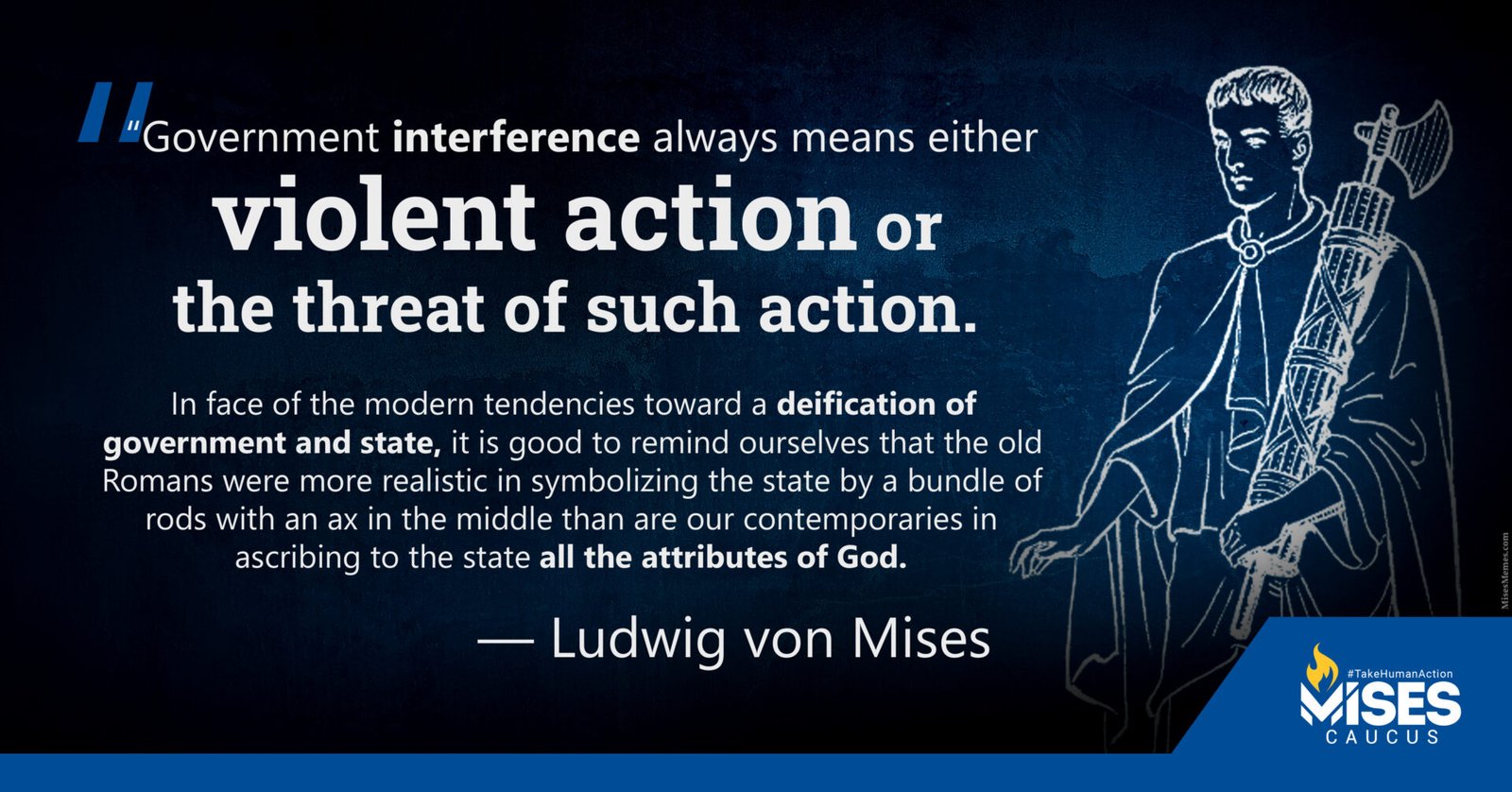
Government interference always means either violent action or the threat of such action. […] In face of the modern tendencies toward a deification of government and state, it is good to remind ourselves that the old Romans were more realistic in symbolizing the state by a bundle of rods with an ax in the middle than are our contemporaries in ascribing to the state all the attributes of God. —Ludwig von Mises
Normal Quality (1920×1005 312 KB)
Government interference always means either violent action or the threat of such action. […] In face of the modern tendencies toward a deification of government and state, it is good to remind ourselves that the old Romans were more realistic in symbolizing the state by a bundle of rods with an ax in the middle than are our contemporaries in ascribing to the state all the attributes of God. —Ludwig von Mises
Normal Quality (1920×1372 443 KB)
Government interference always means either violent action or the threat of such action. […] In face of the modern tendencies toward a deification of government and state, it is good to remind ourselves that the old Romans were more realistic in symbolizing the state by a bundle of rods with an ax in the middle than are our contemporaries in ascribing to the state all the attributes of God. —Ludwig von Mises

Government interference always means either violent action or the threat of such action. […] In face of the modern tendencies toward a deification of government and state, it is good to remind ourselves that the old Romans were more realistic in symbolizing the state by a bundle of rods with an ax in the middle than are our contemporaries in ascribing to the state all the attributes of God. —Ludwig von Mises

1286: Lysander Spooner – Man Refuses to be a Slave

The principle that the majority have a right to rule the minority, practically resolves all government into a mere contest between two bodies of men, as to which of them shall be masters, and which of them slaves; a contest, that-however bloody-can, in the nature of things, never be finally closed, so long as man refuses to be a slave. —Lysander Spooner
Normal Quality (1920×1372 207 KB)
The principle that the majority have a right to rule the minority, practically resolves all government into a mere contest between two bodies of men, as to which of them shall be masters, and which of them slaves; a contest, that-however bloody-can, in the nature of things, never be finally closed, so long as man refuses to be a slave. —Lysander Spooner
Normal Quality (1920×1005 166 KB)
The principle that the majority have a right to rule the minority, practically resolves all government into a mere contest between two bodies of men, as to which of them shall be masters, and which of them slaves; a contest, that-however bloody-can, in the nature of things, never be finally closed, so long as man refuses to be a slave. —Lysander Spooner

The principle that the majority have a right to rule the minority, practically resolves all government into a mere contest between two bodies of men, as to which of them shall be masters, and which of them slaves; a contest, that-however bloody-can, in the nature of things, never be finally closed, so long as man refuses to be a slave. —Lysander Spooner

1283: Stephan Kinsella – The Consistent Libertarian is an Anarchist

Because the state necessarily commits aggression, the consistent libertarian, in opposing aggression, is also an anarchist. —Stephan Kinsella
Normal Quality (1920×1005 240 KB)
Because the state necessarily commits aggression, the consistent libertarian, in opposing aggression, is also an anarchist. —Stephan Kinsella
Normal Quality (1920×1372 316 KB)
Because the state necessarily commits aggression, the consistent libertarian, in opposing aggression, is also an anarchist. —Stephan Kinsella

Because the state necessarily commits aggression, the consistent libertarian, in opposing aggression, is also an anarchist. —Stephan Kinsella

1277: Yeonmi Park – Our Biggest Threat is Government

Nothing has been more dangerous to individuals than government. Our biggest threat is government. —Yeonmi Park
Normal Quality (1920×1005 213 KB)
Nothing has been more dangerous to individuals than government. Our biggest threat is government. —Yeonmi Park
Normal Quality (1920×1372 287 KB)
Nothing has been more dangerous to individuals than government. Our biggest threat is government. —Yeonmi Park

Nothing has been more dangerous to individuals than government. Our biggest threat is government. —Yeonmi Park

1275: Albert Camus – The Alibi of Tyrants

The welfare of the people has always been the alibi of tyrants. —Albert Camus
Normal Quality (1920×1005 208 KB)
The welfare of the people has always been the alibi of tyrants. —Albert Camus
Normal Quality (1920×1372 272 KB)
The welfare of the people has always been the alibi of tyrants. —Albert Camus

The welfare of the people has always been the alibi of tyrants. —Albert Camus

1263: Edward Snowden – Don’t Stay Safe. Stay Free.

Don't stay safe. Stay free. —Edward Snowden
Normal Quality (1920×1005 307 KB)
Don't stay safe. Stay free. —Edward Snowden
Normal Quality (1920×1372 363 KB)
Don't stay safe. Stay free. —Edward Snowden

Don’t stay safe. Stay free. —Edward Snowden

1256: Ron Paul – Rejection of the Initiation of Violence

The most important element of a free society, where individual rights are held in the highest esteem, is the rejection of the initiation of violence. —Ron Paul
Normal Quality (1920×1005 220 KB)
The most important element of a free society, where individual rights are held in the highest esteem, is the rejection of the initiation of violence. —Ron Paul
Normal Quality (1920×1372 304 KB)
The most important element of a free society, where individual rights are held in the highest esteem, is the rejection of the initiation of violence. —Ron Paul

The most important element of a free society, where individual rights are held in the highest esteem, is the rejection of the initiation of violence. —Ron Paul

1251: Murray Rothbard – Taxation is Theft

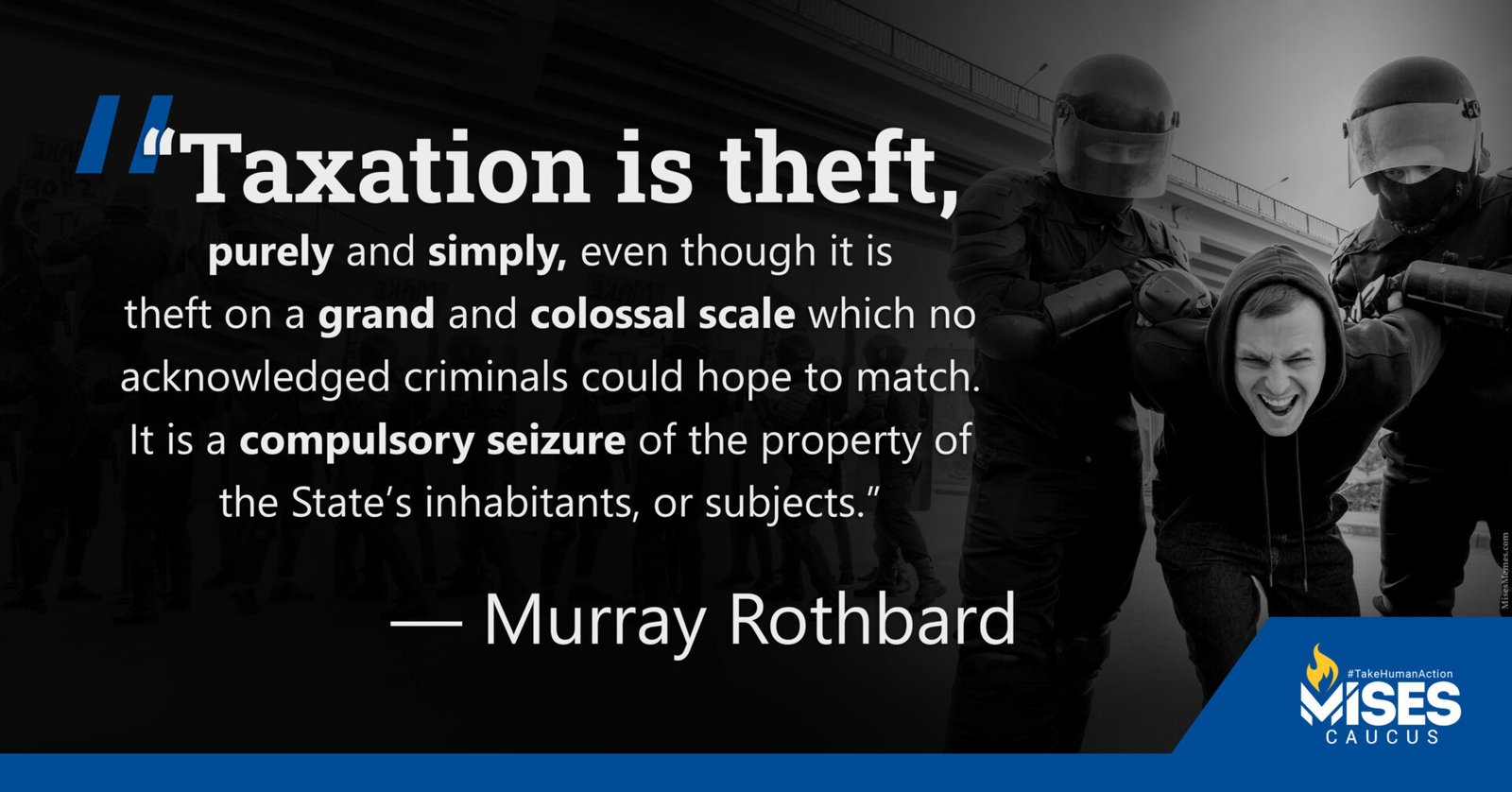
Taxation is theft, purely and simply, even though it is theft on a grand and colossal scale which no acknowledged criminals could hope to match. It is a compulsory seizure of the property of the State’s inhabitants, or subjects.— Murray Rothbard
Normal Quality (1920×1005 181 KB)
Taxation is theft, purely and simply, even though it is theft on a grand and colossal scale which no acknowledged criminals could hope to match. It is a compulsory seizure of the property of the State’s inhabitants, or subjects.— Murray Rothbard
Normal Quality (1920×1372 233 KB)
Taxation is theft, purely and simply, even though it is theft on a grand and colossal scale which no acknowledged criminals could hope to match. It is a compulsory seizure of the property of the State’s inhabitants, or subjects.— Murray Rothbard

Taxation is theft, purely and simply, even though it is theft on a grand and colossal scale which no acknowledged criminals could hope to match. It is a compulsory seizure of the property of the State’s inhabitants, or subjects.— Murray Rothbard

1250: Murray Rothbard – War Increases State Power

It is in war that the State really comes into its own: swelling in power, in number, in pride, in absolute dominion over the economy and the society. —Murray Rothbard
Normal Quality (1920×1005 260 KB)
It is in war that the State really comes into its own: swelling in power, in number, in pride, in absolute dominion over the economy and the society. —Murray Rothbard
Normal Quality (1920×1372 351 KB)
It is in war that the State really comes into its own: swelling in power, in number, in pride, in absolute dominion over the economy and the society. —Murray Rothbard

It is in war that the State really comes into its own: swelling in power, in number, in pride, in absolute dominion over the economy and the society. —Murray Rothbard

1248: Murray Rothbard – Statists are Really Opposed to Charity

Statists, in fact, are really opposed to charity. They often argue that charity is demeaning and degrading to the recipient, and that he should therefore be taught that the money is rightly his, to be given to him by the government as his due. An act of charity, when given voluntarily, is generally considered temporary and offered with the object of helping a man to help himself. But when the dole is ladled out by the State, it becomes permanent and perpetually degrading, keeping the recipients in a state of subservience. Anyone who considers private charity degrading must logically conclude that State charity is far more so. —Murray Rothbard
Normal Quality (3840×2010 146 KB)
Statists, in fact, are really opposed to charity. They often argue that charity is demeaning and degrading to the recipient, and that he should therefore be taught that the money is rightly his, to be given to him by the government as his due. An act of charity, when given voluntarily, is generally considered temporary and offered with the object of helping a man to help himself. But when the dole is ladled out by the State, it becomes permanent and perpetually degrading, keeping the recipients in a state of subservience. Anyone who considers private charity degrading must logically conclude that State charity is far more so. —Murray Rothbard
Normal Quality (2900×3840 157 KB)

Statists, in fact, are really opposed to charity. They often argue that charity is demeaning and degrading to the recipient, and that he should therefore be taught that the money is rightly his, to be given to him by the government as his due. An act of charity, when given voluntarily, is generally considered temporary and offered with the object of helping a man to help himself. But when the dole is ladled out by the State, it becomes permanent and perpetually degrading, keeping the recipients in a state of subservience. Anyone who considers private charity degrading must logically conclude that State charity is far more so. —Murray Rothbard